Opera in Comics

Opera in Comics

Giuseppe Fortunino Francesco Verdi (Italian: [dʒuˈzɛppe ˈverdi]; 9 or 10 October 1813 – 27 January 1901) was an Italian opera composer. He was born near Busseto to a provincial family of moderate means, and developed a musical education with the help of a local patron. Verdi came to dominate the Italian opera scene after the era of Vincenzo Bellini, Gaetano Donizetti, and Gioachino Rossini, whose works significantly influenced him.

In his early operas, Verdi demonstrated a sympathy with the Risorgimento movement which sought the unification of Italy. He also participated briefly as an elected politician. The chorus “Va, pensiero” from his early opera Nabucco (1842), and similar choruses in later operas, were much in the spirit of the unification movement, and the composer himself became esteemed as a representative of these ideals. An intensely private person, Verdi, however, did not seek to ingratiate himself with popular movements and as he became professionally successful was able to reduce his operatic workload and sought to establish himself as a landowner in his native region. He surprised the musical world by returning, after his success with the opera Aida (1871), with three late masterpieces: his Requiem (1874), and the operas Otello (1887) and Falstaff (1893).

His operas remain extremely popular, especially the three peaks of his ‘middle period’: Rigoletto, Il trovatore and La traviata, and the 2013 bicentenary of his birth was widely celebrated in broadcasts and performances.

Nabucco (Italian pronunciation: [naˈbukko], short for Nabucodonosor [naˌbukoˈdɔːnozor, -donoˈzɔr]; English: “Nebuchadnezzar”), is an Italian-language opera in four acts composed in 1841 by Giuseppe Verdi to an Italian libretto by Temistocle Solera. The libretto is based on the biblical books of 2 Kings, Jeremiah, Lamentations and Daniel and the 1836 play by Auguste Anicet-Bourgeois and Francis Cornu. However, Antonio Cortese’s ballet adaptation of the play (with its necessary simplifications), given at La Scala in 1836, was a more important source for Solera than was the play itself.Under its original name of Nabucodonosor, the opera was first performed at La Scala in Milan on 9 March 1842.

Nabucco is the opera that is considered to have permanently established Verdi’s reputation as a composer. He commented that “this is the opera with which my artistic career really begins. And though I had many difficulties to fight against, it is certain that Nabucco was born under a lucky star.”

The opera follows the plight of the Jews as they are assaulted, conquered and subsequently exiled from their homeland by the Babylonian king Nabucco (Nebuchadnezzar II). The historical events are used as background for a romantic and political plot. The best-known number from the opera is the “Chorus of the Hebrew Slaves”, “Va, pensiero, sull’ali dorate” / “Fly, thought, on golden wings”, a chorus that is regularly given an encore in many opera houses when performed today.

“Va, pensiero” (Italian: [ˈva penˈsjɛːro]), also known as the “Chorus of the Hebrew Slaves”, is a chorus from the opera Nabucco (1842) by Giuseppe Verdi. It recollects the period of Babylonian captivity after the loss of the First Temple in Jerusalem in 586 BCE.

The libretto is by Temistocle Solera, inspired by Psalm 137. The opera with its powerful chorus established Verdi as a major composer in 19th-century Italy. The full incipit is “Va, pensiero, sull’ali dorate”, meaning “Go, thought, on wings of gold”.

Born today Sergio Tòfano

Born today Sergio Tòfano

Sergio Tòfano, signed STO, (20 August 1886 – 28 October 1973, Italy) son of a magistrate followed legal studies. At the same time, he studied theater in Rome. Starting in 1909, Tòfano played with several theater groups. At the same time, he took on a career as an illustrator under the pseudonym Sto.

He started out illustrating covers for Il Giornalino della Domenica. From 1914 to 1923, he was one of the main collaborators on the humorous and satirical periodical, Il Numero. In 1917, for Il Corriere dei Piccoli, he started his series ‘Bonaventura’, which he drew until 1953. Sto also used Bonaventura in several theatre plays, as well as a movie

My Dad Walt Disney

My Dad Walt Disney

My Dad Walt Disney by Diane Disney Miller

Movie Posters by Galep 1946 handmade originals

Movie Posters by Galep 1946 handmade originals

Galep painted many of movie posters, just in one copy for the movie theater. 

Here only three survived.

Le tre Sorelle The Gay Sisters (original title)

Un uomo ritorna

Spavalderia The Bowery (original title)

Chris Tower & Chris Tower

Chris Tower & Chris Tower

Tales of the Green Beret is an American comic strip created by the nonfiction author Robin Moore and artist Joe Kubert.

Published in the 1960s, its Vietnam War setting was concurrent with the controversial real-life conflict.

Xtina Comic Strip Closed for Vacation

Xtina Comic Strip Closed for Vacation

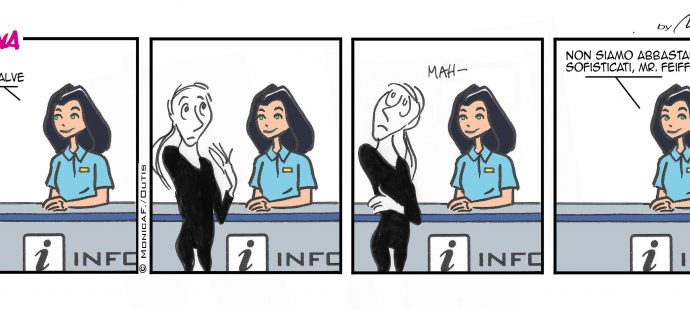
Centered on the life of Xtina, in her work as assistant in a Museum, Xtina’s chronicles the daily challenges of a worker. At work, we follow xtina as she copes with friends, relationships, and the day-to-day trials of a working woman living life in the 21st century.

Ferragosto with Sor Pampurio

Ferragosto with Sor Pampurio

Sor Pampurio is an Italian comic strip series created by Carlo Bisi.
Started in 1929, the comic strips were published, with some breaks, by Il Corriere dei Piccoli until 1978. Every episode starts depicting Sor Pampurio (“Mr. Pampurio”)’s happiness about his new house, a happiness that turns in a few frames, for a reason or another, in an increasing discontent and in a new moving at the end of any story.

Carlo Bisi (18 December 1890 – 27 February 1982, Italy)  was the author of ‘Sor Pampurio’, one of the most popular comics of the Il Corrière dei Piccoli periodical. The series, about the life and times of an upper-middle-class Italian family appeared from 1929 to 1941.
The funny images, drawn in an almost two-dimensional style, were accompanied by funny rhymes. Bisi was a graduate of the Academy of Fine Arts of Parma. Later in his career, Bisi illustrated for several publishing houses.

Courtesy Lambiek.net

Western comic book- New artists are welcomed

Western comic book- New artists are welcomed

Western comics is a comics genre usually depicting the American Old West frontier (usually anywhere west of the Mississippi River) and typically set during the late nineteenth century.

The term is generally associated with an American comic books genre published from the late 1940s through the 1950s (though the genre had continuing popularity in Europe, and persists in limited form in American comics today). Western comics of the period typically featured dramatic scripts about cowboys, gunfighters, lawmen, bounty hunters, outlaws, and Native Americans.

Accompanying artwork depicted a rural America populated with such iconic images as guns, cowboy hats, vests, horses, saloons, ranches, and deserts, contemporaneous with the setting.

Historical graphic novel seeks artist

Historical graphic novel seeks artist

Historical graphic novel, Italy, 15th century.

We love Enrico Marini‘s art but any style is accepted.

Born today Tito Marchioro

Born today Tito Marchioro

Tito Marchioro Tito Marchioro (Venezia, 12 agosto 1931 – Venezia, 16 febbraio 2004) was an Italian artist who worked for French publishers like Aventures et Voyages in the 1970s. He drew ‘Johnny Speed’ in Safari, ‘Texas Bill’ in Apaches and ‘Sylver des Collines’ in Marco Polo (script by Roger Lécureux and Jean Ollivier). In Italy he is known as an illustrator of erotic comics for Ediperiodici (‘Lucifera’) and Edifumetto (‘La Peccatrice’).

courtesy Lambiek.net