Tag Archivio per: casarotto.uk.com

my Prince Valiant

When I met the Prince.

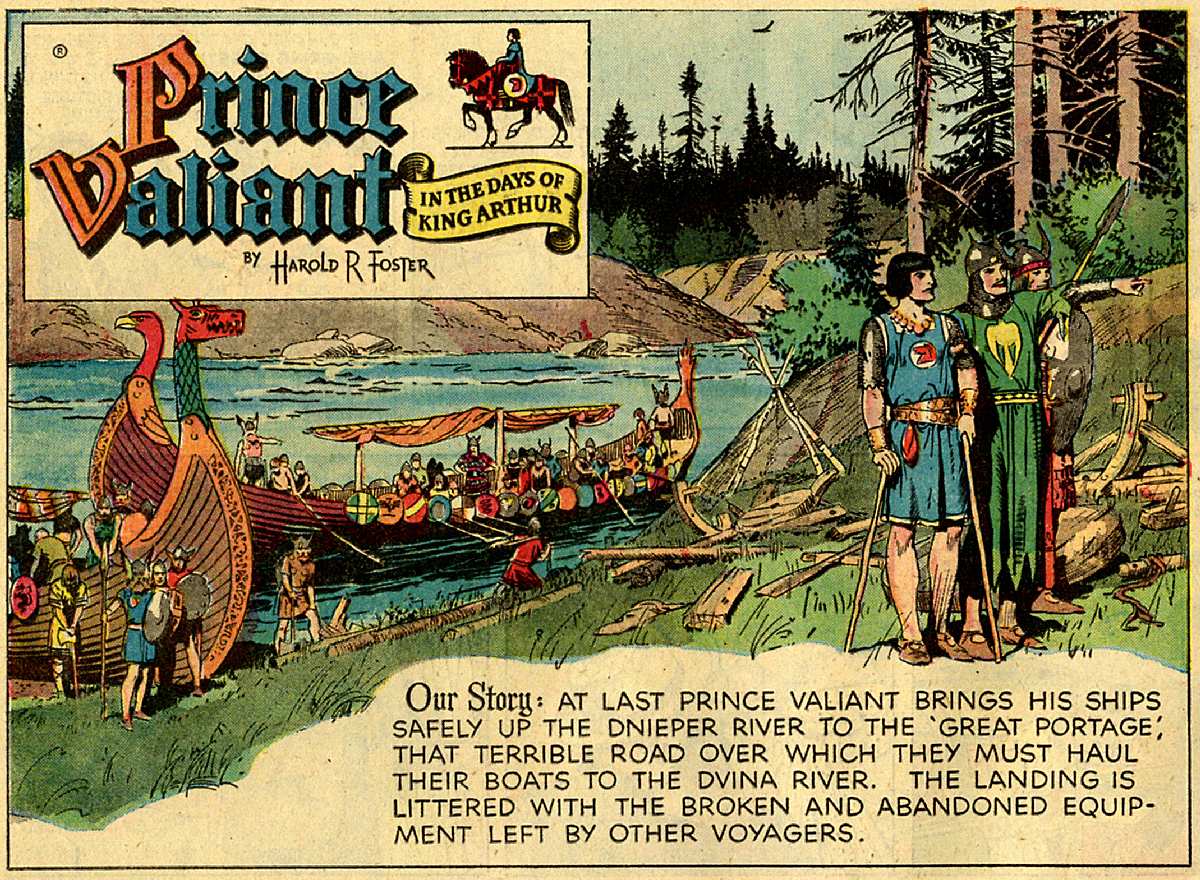
I remember that, at the age of 7 or 8 years old, we were living in a friend’s house in Burbank. I can still recall the nice house on a hill with a park just down the road. Dad, who noticed how easily I got bored would bring me along to visit the spots in the district, in search of a location for the strips he was preparing. We would often stop for breakfast at his friend H’s place, who also had a huge collection of original comics and strips. It was during one of these visits that I met Prince Valiant of Harold Foster. Dad’s friend did not have – strange to say – a fetishistic rapport with his collections. He did keep the originals in transparent envelopes, (acid-free for sure) but allowed me to take a look, leaf through them without manifesting any anxiety. I recall those tables, that were just my height. Sprawled on the carpet of the study and with the pages strewn all over the place, I would practically immerse myself in those gigantic pages.
Monica

Harold-Foster-El-Principe-Valiente


PRINCE VALIANT STORY INDEX 

Story 1) Pages #1(13 Feb 1937) – #4(6 Mar 1937) Into the Fens 
(King Aguar introduced page #1, Prince Valiant page #2) 
2) #4(6 Mar 37) – 11 (24 Apr 37) The Prophecy 
(Horrit the Witch introduced page #5) 
3) #11(24 Apr 37) – 15(22 May 37) The Home-made Knight 
4) #16(29 May 37) – 20(26 June 37) The Trial of Sir Negarth 
(Sir Gawain introduced page #16, Camelot, King Arthur, 
Guinevere, Merlin page #19) 
5) #21(3 Jul 37) – 22(10 Jul 37) From Throne Room to Dungeon 
6) #23(17 Jul 37) – 38(30 Oct 37) The Fake Quest 
7) #39(6 Nov 37) – 55(26 Feb 3Cool The Maid Ilene 
Cool#55(26 Feb 3Cool – 64(30 Apr 3Cool The Sorceress 
9) #64(30 Apr 3
Cool – 85(25 Sep 3Cool Ilene Abducted 
10) #86(2 Oct 3
Cool-103(29 Jan 39) The Saxon Invasion of Britain 
(Val knighted in page 103) 
11) #104(5 Feb. 39) – 107(26 Feb 39) The Bargain 
12) #107(26 Feb 39) – 111(26 Mar 39) Claris 
13) #112(2 Apr 39) – 117(7 May 39) The Cave of Time 
14) #118(14 May 39)-127(16 Jul 39) Andelkrag, the Unconquerable 
15) #128 (23 Jul 39) – 169(5 May 40) The Legion of Hun-Hunters 
16) #169(5 May 40) – 187(8 Sep 40) The Road to Rome 
(Note: In this story the approximate dating of Val’s saga 
is explicitly indicated for the first time, when page 183 
mentions that the fall of the Roman Empire at Ravenna, will be 
about 20 years later. This and the depiction of the fall of 
the Huns in the previous stories places these adventures 
in the 450’s AD. See chronology, Appendix 1). 
17) #188(15 Sep 40) – 199(1 Dec 40) Valentinian’s Justice 
1
Cool #199(1 Dec 40) – 246(26 Oct 41) Fights for the Singing Sword 
(Queen Aleta introduced page #208) 
19) #246(26 Oct 41) – 253(14 Dec 41) The Misty Isles 
20) #253(14 Dec 41) – 289(23 Aug 42) Homeward Bound 
(Pirate Boltar introduced page #253) 
21) #290(30 Aug 42) – 311(24 Jan 43) The Roman Wall 
22) #311(24 Jan 43) – 317(7 Mar 43) Merlin Solves a Problem 
23) #318(14 Mar 43) – 350(24 Oct 43) The Long Voyage to Thule 
24) #351 (31 Oct 43) – 354(21 Nov 43) The Seductress 
25) #355(28 Nov 43) – 358(19 Dec 43) The Call of the Sea 
26) #358(19 Dec 43) – 363(23 Jan 44) The Jealous Cripple 
(Gundar Harl introduced page #360) 
27) #363(23 Jan 44) – 368(27 Feb 44) A Quick, Bloody Battle 
2
Cool #368(27 Feb 44) – 378(7 May 44) The Rewards of Treachery 
(Note: In 1944-1945 Foster devoted the bottom 1/3 of his 
page to “The Medieval Castle”) 
29) #379(14 May 44) – 468(27 Jan 46) “The Winning of Aleta” 
30) #465(6 Jan 46) – 484(19 May 46) Matrimony 
(Note: Val and Aleta married, page 470, during sack of Rome, 
which occurred in AD 455, used as our time reference. 
Katwin introduced page #480). 
31) #484(19 May 46) – 504(6 Oct 46) War in the Forest 
32) #504(6 Oct 46) – 507(20 Oct 46) Self-Sacrifice 
33) #507(27 Oct 46) – 519(19 Jan 47) Aguar’s Daughter-in-Law 
34) #520(26 Jan 47) – 594(18 Apr 4
Cool The New World 
(Note: Arn born page #551, Tillicum introduced page #549). 
35) #595(4 Jul 4
Cool – 615(21 Nov 4Cool The Mad King 
36) #616(28 Nov 4
Cool As Arn Tells It 
37) #617(5 Dec 4
Cool – 624(23 Jan 49) The Christening 
3
Cool #624(23 Jan 49) – 643(5 June 49) Black Magic in Wales 
39) #644(12 June 49) – 647(3 July 49) The Ambitious Boy 
(Note: Introduced in page #644, Geoffrey is to 
become the official historian of Prince Valiant.) 
40) #647(3 July 49) – 675(15 Jan 50) Into Scotland 
41) #675(15 Jan 50) – 683(12 Mar 50) Home Again 
42) #684(19 Mar 50) My Sword 
43) #685(26 Mar 50) – 691(7 May 50) The Challenge 
44) #691(7 May 50) – 758(19 Aug 51) The Missionaries 
45) #758(19 Aug 51) – 767(21 Oct 51) “?” 
(Twins introduced page #767) 
46) #767(21 Oct 51) – 769(4 Nov 51) The Prince Arn Story 
47) #770(1 Nov 51) – 782(3 Feb 52) The King’s Justice 
(Note: Boltar and Tillicum marry page 782) 
4
Cool #782(3 Feb 52) – 790(30 Mar 52) A Little Hunting 
49) #791(6 Apr 52) – 794(27 Apr 52) The Wager or Val Eats Crow 
50) #794(27 Apr 52) – 796(11 May 52) Another Christening 
(Note: Baby girls christened Valeta and Karen). 
51) #797(18 May 52) – 799(1 June 52) The Stolen River 
52) #799(1 June 52) – 810(17 Aug 52) Sigurd’s Doom 
53) #811(24 Aug 52) – 816(28 Sept 52) The Story Teller 
54) #817(5 Oct 52) The Huntsman 
55) #818(12 Oct 52) – 825(30 Nov 52) Kidnapped 
56) #826(7 Dec 52) – 836(15 Feb 53) Valhalla 
57) #837(22 Feb 53) – 840(15 Mar 53) The Explorer 
5
Cool #841(22 Mar 53) – 851(31 May 53) The Vanishing Army 
59) #852(7 June 53) – 869(4 Oct 53) The Rule of Irish Kings 
60) #870(11 Oct 53) – 879(13 Dec 53) Merlin’s Message 
61) #879(13 Dec 53) – 897(18 Apr 54) Under the Frivolous Curls 
62) #898(24 Apr 54) Prince Arn and the Sorceress 
63) #899(2 May 54) – 917(5 Sept 54) The Pilgrimage 
64) #918(12 Sept 54) – 931(12 Dec 54) Back in the Misty Isles 
65) #932 (19 Dec 54) – 988(15 Jan 56) The Strange Route 
66) #988(15 Jan 56) – 995(4 Mar 56) Into the Wilderness 
67) #996(11 Mar 56) – 1006(20 May 56) The Wolf at the Door 
6
Cool #1006(20 May 56) – 1022(9 Sep 56) Survival 
69) #1023(16 Sep 56) – 1029(28 Oct 56) Tournament Days 
70) #1029(28 Oct 56) – 1062(16 Jun 57) Trouble in Cornwall 
71) #1062(16 Jun 57) – 1074(8 Sep 57) The Red Stallion 
(Introduction Arvak, Val’s warhorse). 
72) #1075(15 Sep 57) – 1083(10 Nov 57) Three Men and a Horse 
73) #1084(17 Nov 57) – 1090(29 Dec 57) The Exchange 
74) #1091(1 Jan 5
Cool – 20 Apr 5Cool The Wanderer 
75) #1106(20 Apr 5
Cool – 1133(26 Oct 5Cool Reckless Youth 
76) #1133(26 Oct 5
Cool – 1137(23 Nov 5Cool The Jealousy of A Queen 
77) #1137(23 Nov 5
Cool – 1152(8 Mar 59) The Singer in the Tower 
(Note: Merlin led away into limbo by Nimue, appears 
for the last time in page #1141). 
7
Cool #1153(15 Mar 59) – 1162(17 May 59) Kerwin’s Ordeal 
79) #1162(17 May 59) – 1174(9 Aug 59) The Marriage Contract 
80) #1175(16 Aug 59) – 1187(8 Nov 59) The Earl’s Justice 
81) #1187(8 Nov 59) – 1217(5 June 60) The Grail Quest 
82) #1217(5 June 60) – 1225(31 Jul 60) The Mad Warrior 
83) #1225(31 Jul 60) – 1249 (15 Jan 61) The Abdication 
(Note: Arn abdicates position as heir to 
Misty Isles in favor of his new baby brother). 
84) #1249(15 Jan 61) – 1259(26 Mar 61) Kidnapped 
85) #1260(2 Apr 61) – 1263(23 Apr 61) The New Era 
(New baby boy christened Galan).
 
86) #1263(23 Apr 61) – 1292(12 Nov 61) The Business Trip 
87) #1293(19 Nov 61) – 1302(21 Jan 62) Rome 
8
Cool #1303(28 Jan 62) – 1327(8 Jul 62) The Overland Trade Route 
89) #1329(29 Jul 62) – 1331(12 Aug 62) Arvak the Wild 
90) #1328(22 Jul 62) – 1342(28 Oct 62) The Voice 
91) #1357(10 Feb 63) – 1374(9 Jun 63) War Clouds 
92) #1375(16 Jun 63) – 1383(11 Aug 63) The Rustic Knights 
93) #1384(18 Aug 63) – 1393(20 Oct 63) Seeds of Revolt 
94) #1393(20 Oct 63) – 1403(29 Dec 63) Saxons in the Vale 
95) #1404(5 Jan 64) – 1417(5 Apr 64) Another Abduction 
96) #1417(5 Apr 64) – 1436(16 Aug 64) The Battle of Badon Hill 
97) #1435(9 Aug 64) – 1442(27 Sept 64) The Matchmakers 
9
Cool #1442(27 Sept 64) – 1455(27 Dec 64) Guerilla War in Thule 
99) #1455(27 Dec 64) – 1532(19 June 66) Arn in The New World 
100) #1533(26 Jun 66) – 1551(30 Oct 66) Mordred’s Intrigue 
101) #1552(6 Nov 66) – 1555(27 Nov 66) The Mermaid 
102) #1556(4 Dec 66) – 1567(19 Feb 67) The Missing Heir 
103) #1567(19 Feb 67) – 1592(13 Aug 67) Enter Sir Reynolde 
104) #1591(6 Aug 67) – 1599(1 Oct 67) To Have and to Hold 
105) #1600(8 Oct 67) – 1605(12 Nov 67) The Beserker 
106) #1606(19 Nov 67) – 1621(3 March 6
Cool Slaves in Dathram 
107) #1622(10 Mar 6
Cool – 1635(9 June 6Cool Trouble in the Isles 
108) #1635(9 Jun 6
Cool – 1646(25 Aug 6Cool Ortho Bey 
109) #1646(25 Aug 6
Cool – 1650(22 Sept 6Cool At Home with the Kids 
110) #1651(29 Sep 6
Cool – 1672(23 Feb 69) Return to Britain 
(Note: Final app. Katwin, who marries Captain Helge Hakkon) 
111) #1672(23 Feb 69) – 1681(27 Apr 69) Gawain’s Misadventures 
112) #1682(4 May 69) – 1683(11 May 69) Arn, the Poacher 
113) #1683(11 May 69) – 1696(10 Aug 69) The Saxon Dilemma 
114) #1697(17 Aug 69) – 1705(12 Oct 69) Who Breaks the Peace? 
115) #1705(
12 Oct 69) – 1708(2 Nov 69The Enchantress 
116) #1708(
2 Nov 69) – 1716(28 Dec 69) Geoffrey’s Fulfillment 
117) #1717(
4 Jan 70) – 1727(15 Mar 70) Arn’s Servitude 
118) #1728(
22 Mar 70) – 1731(12 Apr 70) The Vanishing Deer 
119) #1732(
19 Apr 70) – 1759(25 Oct 70) Ah! Women! 
(Note: Page 1757 ghosted by Gray Morrow) 
120) #1759(25 Oct 70) – 1815(21 Nov 71) The End of Romance 
(Note: Pages 1760,1764-1767, 1769-1772, 1774, 1775, 1777-87 
drawn by John Cullen Murphy, who took over art from Foster 
after page 1788 (Foster’s last except for Page 2000. 
Page 1762 ghosted by Wallace Wood). 
121) #1816(28 Nov 71) – 1821(2 Jan 72) The Vanishing Groom 
122) #1822(9 Jan 72) – 1834(2 Apr 72) The Indolent City 
123) #1835(9 Apr 72) – 1841(21 May 72) Theft of the Singing Sword 
124) #1842(28 May 72) – 1859(24 Sept 72) The Lonely King 
125) #1860(1 Oct 72) The Romancers 
126) #1861(8 Oct 72) – 1870(10 Dec 72) The Amorous Poet 
127) #1870(10 Dec 72) – 1885(25 Mar 73) Boltarson 
128) #1885(25 Mar 73) – 1959(25 Aug 74) Arn’s Adventures 
(Note: Introduction of Lydia, Haakon’s Daughter, Arn’s fiancee). 
129) #1960(1 Sept 74) – 1972(24 Nov 74) Karak the Terrible 
130) #1972(24 Nov 74) – 1975(15 Dec 74) The Improbable Journey 
131) #1975(115 Dec 74) – 1980(19 Jan 75) The Lady of Quality 
132) #1981(26 Jan 75) – 1999(1 Jun 75) The Pirate Raid 
133) #2000 (8 Jun 75) Milestones in the Story of Prince Valiant 
(Note: Foster’s last signed page. Reprinted as large color
poster by King Features.
 Foster was said to have continued 

doing the scripts and coloring for several more years). 
134) #2001(15 Jun 75) – 2032(18 Jan 76) Another Eventful Journey 
135) #2032(18 Jan 76) – 2050(23 May 76) Treasure of the Bats 
136) #2050(23 May 76) – 2076(21 Nov 76) The Quest for Helene 
137) #2077(28 Nov 76) – 2093(29 Mar 77) King of the Minstrels 
138) #2093(20 Mar 77) – 2110(17 Jul 77) Quest for the Relics 
139) #2111(24 Jul 77) – 2128(20 Nov 77) Petropolis 
140) #2129(27 Nov 77) – 2138(29 Jan 77) Here Come the Amazons 
141) #2138(29 Jan 7
Cool – 2156(4 Jun 7Cool Return to Camelot 
142) #2157(11 Jun 7
Cool – 2164(30 Jul 7Cool Conflict at Camelot 
143) #2165(6 Aug 7
Cool – 2173(1 Oct 7Cool The Sinister Stronghold 
144) #2173(1 Oct 7
Cool – 2180(19 Nov 7Cool The Snowslide 
(Note: Death of Lydia). 
145) #2180(19 Nov 7
Cool – 2197(18 Mar 79) The Neglected Bride-to-Be 
146) #2193(18 Feb 79) – 2202(22 Apr 79) A Family Affair 
147) #2200(8 Apr 79) – 2207(27 May 79) The Towering Giant 
148) #2207(27 May 79) – 2209(10 Jun 79) Arvak’s Daughter 
(Note: Arvak, Val’s faithful red stallion, dies of old age). 
149) #2209(10 Jun 79) – 2225(30 Sep 79) Galan Enters A New World 
150) #2226(7 Oct 79) – 2246(24 Feb 80) Trouble in the Irish Sea 
(Note: End of involvement by Foster, who sold rights to 
PV to King Features and retired late 1979 at age 87. 
Subsequently John Cullen Murphy’s own signature 
appeared for the first time, and the subtitle “Created by 
Hal Foster” was added to the Prince Valiant logo). 

Comic Strips French Golden Age: Hoviv

Hoviv, Basile, 1966 dans Tintin magazine.

Hoviv (de son vrai nom René Hovivian) est un dessinateur humoristique français né en 1929 à Vienne (Isère) et décédé le 28 mai 2005 à Clamart.

En 1946, à 17 ans, il entre aux beaux-arts de Lyon et publie ses premières bandes dessinées «SOS Dakota » et « Indianapolis Sanglant ». L’année suivante, en 1947, il part s’installer en Arménie soviétique avec sa famille et ne reviendra en France qu’en 1964.

Comme des milliers d’autres Arméniens attirés par le «Paradis Communiste», sa famille quitte la France pour l’Arménie soviétique, pays de l’URSS . Là, il rentre à l’usine et devient soudeur à l’arc, mais en 1949 lui et sa famille sont déportés en Sibérie centrale, dans la Taïga (son père ayant été soupçonné de sympathies Dachnak). Il y sera bûcheron. Libéré en 1956, il s’installe à Moscou un an plus tard et entre aux studios de Cinéma d’état. Il y apprend le dessin animé et participe à plusieurs créations. Il commence sa carrière de dessinateur humoristique en publiant dans les principaux journaux et magazines moscovites dont Krokodil, Ogonek , les Nouvelles de Moscou. En France dans les années 1980, il s’engagera en politique à droite.

Ses dessins ont été publiés dans de nombreux journaux : Le Hérisson, Marius, Ici Paris, Jours de France, Lui, Le Quotidien de Paris, ainsi que dans divers ouvrages, dont Je réussis mon entretien d’embauche et CV : les lettres clés de ma carrière, de Marie-Françoise Guignard et Jean-Pierre Thiollet, parus à plusieurs reprises, aux Editions Amarande puis chez Jean-Cyrille Godefroy.

Beaucoup de ses dessins ont pour sujet le sexe (notamment la série Les Mâles) ou la politique (par exemple « Les Kamarades »). Vers la fin de sa vie, il publiera deux albums sur la diaspora arménienne, sa communauté d’origine.


from wikipedia

the Sunday of Xtina

the Sunday of Xtina is a comic-strip created by Monica

Xtina comic strips are centered on the life of Xtina in her work as assistant in a Museum. Xtina’s chronicles the daily challenges of a worker. At work, we follow Xtina as she copes with friends, relationships, and the day-to-day trials of a working woman living life in the 21st century.

Xtina’s comic-strip, subject, Art and Script-writer:

Dalla presentazione di Gianfranco Goria:

Eccola qui, Monica (figlia d’arte, mi dicono, con una naturale propensione, si direbbe, per le strip statunitensi, così efficaci, così difficili da fare bene). Eccola col suo tratto essenziale e pulito (perfetto per la rete, ma pubblicato sulla carta stampata), da leggere con leggerezza per ricavarne un sorriso e qualche pensiero intelligente.

Al momento l’autrice ha appena qualche anno in più della protagonista della sua striscia, XTINA, lavoratrice museuale diciannovenne ingabbiata in quel banco informazioni che, se da un lato la rende libera e autonoma, dall’altro la costringe a fuggire costantemente con la fantasia (da ex impiegato di concetto,  come la capisco…). L’arte arriva fino a quel banco, anche se magari non nel modo che la ragazza avrebbe voluto, ma non è l’unica a desiderare di più per la propria vita: c’è anche, per dire, un giovane in divisa che, per ora, sembra davvero fare tanta fatica a trovare quel che cerca… Ma, no, non ci si deve rassegnare! Oh, no. C’è tutta una vita davanti! In fondo “un anno nuovo è un foglio bianco tutto da scrivere”… Oh… cioé… insomma… cestini permettendo.

Immagino le sue giovani lettrici, immedesimarsi con estrema facilità. Immagino i padri delle sue lettrici, riconoscere (e forse scoprire) le proprie figlie. Immagino altre strisce e altre ancora che verranno e mi chiedo se XTINA crescerà anche lei, nel suo mondo a strisce, e troverà le cose belle della vita che la attendono, appena un poco più in là.

the Reporters volume 2 episode 10

The adventures of The reporters (episode #9), two T. V. journalists whose jobs lead them to come up against major and minor dramas.

To give an idea of the style, their stories resemble the T. V. series Hill Street Blues and N.Y. Police Dept. Besides the story, the human side of the main characters and their interpersonal relationships are developed.

The main characters:

Harry, the eldest, once a newspaper reporter (like Lou Grant) changed over to T. V. during the Vietnam period. His thorny character keeps him away from office work and leads him to work out and about with his colleague Allen. Divorced, his wife Linda does not want to see him so he communicates through their daughter Kay, who lives with him.

Allen, Harrys young colleague, whose experience so far has been in television, has been teamed up with the older man to learn the trade. More easy-going and lighter-hearted, a sense of genuine affection binds him to Harry and his feelings for Kay go even deeper.

Kay, Harrys 18 years old daughter is her sophomore year of college majoring in English literature. Even though she has nothing to do with the work of her father and Allen, she seems to fit in with them perfectly. She longs to eventually become a script writer and her closeness to Hollywood is for her a constant inspiration. She is not unaware of Allens shy advances but she keeps him at a distance while at the same time stringing him along.

Four episodes made so far:

1) An elderly rival journalist, who feels his life is passing before him without his having accomplished anything, gets into serious trouble by trying to murder someone so as to be able to do a good deed.

2) Misguided young journalist friend of Allens pointlessly needles the powers that be of the gangster world by creating a fake scoop.

3) Harry passes up a scoop so as not to ruin the few remaining months left in the life of an elderly actor forced to make soap operas to survive.

4) Kay, attracted by the movie world, meets a director but her life is endangered by the mans mental instability, brought to a peak by  divorce.

reporters02_10ITA


Anna & Mathias in Venice episode 24

Anna and Mathias adventure in Venice

STORY/ART: Giancarlo Malagutti

GENRE: Adventure/Mystery/Thriller/Fantasy

TARGET READERSHIP: All ages, both sexes

SETTING: Well known and characteristic cities and locations in Italy

SET IN: The Present Day

STRUCTURE & TONE OF THE STORIES: The two protagonists in this series are children and, despite their superhuman potentialities, they behave as such. They always travel accompanied by an adult, they never go out late at night and wherever they stay they’re in the company of relatives. It is within this context that the storyline develops in its own way. They’re not out to put the world to rights, yet they are endowed with a strong sense of justice and they seek to do good in the face of evil.

COLLECTION: Each episode is 44 pages long and is a complete and free-standing story.

Reading them in order is recommended. In full colors.

5 episodes ready for print.

THE PROTAGONISTS:

Mathias is a blond 10 year-old. He’s knowledgeable for his age as a result of his somewhat cosmopolitan education.

Anna is a freckly 10 year-old redhead. Orphaned at an early age she has an elderly bedridden granny. Lively, intelligent and with a searching mind, she’s the one with the sense of humour and sharp one liners.

ARTIST BIO: Giancarlo Malagutti began his career in 1973 by drawing cartoons for the monthly publication Horror. He has worked alongside Renzo Barbieri and Giorgio Cavedon on several cartoons. Malagutti has drawn several one off short stories for Intrepido, Monello and Albo TV and has inked the drawings of Sergio Zaniboni for Diabolik which is where he began to write scripts. In 1981 he began freelancing for IF, working on Japanese cartoons including Princess Zaffiro, Tiger Man and Bia. In 1982 he created the series The Reporters drawn by Zaniboni for Orient Express. After having written a story line for Martin Mystère he worked as a commercial artist for some twelve years until 1994 when he resumed his work in cartoons, writing stories for Lupo Alberto, Cattivik and Mystère. Most recently he has been working on the characters of Chris Carella in collaboration with Sergio Zaniboni and both the drawings and script for Mathias www.mathias.is.it

(For a short biography visit http://www.lambiek.net/artists/m/malagutti_giancarlo.htm)

Personnages principaux:

Mathias est un normal garcon de 9 ans, blondin, mignon. fils de parents aisés qui, à cause de leur travail, lui font parcourir le vaste monde. Il a une bonne culture, malgré son âge, grâce a sa formation cosmopolite. En certaines situations, spécialement lorsque il est sous stress, il réussit à modifier (pour des petites choses) la réalité.

Anna: fillette de 9 ans, cheveux roux et lentilles. Orpheline, elle vit avec une grand-mère agée immobilisée au lit. Tres éveillée, intelligente et curieuse. C’est elle qui s’occupe de sa grand-mère. Elle vit avec l’épée de Damoclés d’être envoyée dans un orphelinat et sa grand-mère expediée à l’hospice de pauvres. très indigente, son unique revenu est la pension de sa grand-mère. Elle parâit seulement dans cet épisode mais elle peut revenir.

Texte/dessins: Giancarlo Malagutti

Genre: mystery/humour/ fantasy

Target: 8/12 ans (mais adultes aussi)

Recostitution: World

Epoque: de notre temps

Giancarlo Malagutti.

Il fait ses débuts en 1973 en réalisant les crayons de quelques histires pour la publication mensuelle Horror (Ed.Astoria). Il dessine quelques histoire sur L’Intrepido, L’Albo et Il Monello (Ed. Universo), Il encre les crayons de S.Zaniboni pour Diabolik. En 1981 il réalise  la version en bandes dessinées des séries  télévisées de Princesse Saphir, Homme Tigre, Bia. En 1982 il crée la série “The Reporters” dessinée par Sergio Zaniboni. Aprés avoir écrit pour Martin Mystére (Sergio Bonelli Editore), il se consacre au travail publicitaire et quitte pour le moment l’activité d’auteur de BD  qu’il reprend quelques années aprés en écrivant des scénarios de Lupo Alberto et Cattivik (Acme/macchia nera) et Martin Mystére.

Princess Zaffiro download fumetto/manga italiano

Princess Zaffiro, rendiamo disponibile il download di un episodio dopo il volume che raccoglie le avventure italiane di Malagutti/Truscia/Messora. A seguire gli altri.

[wpdm_package id=’3314′]


La principessa Zaffiro (リボンの騎士 Ribon no kishi lett. “Cavaliere del nastro”) è una serie manga di Osamu Tezuka (conosciuto come il creatore di Astro Boy), successivamente trasposto in animazione dalla Mushi Productions, società di proprietà dello stesso Tezuka. È il primo shōjo manga che è diventato un anime nella storia dell’animazione, nonché uno dei primi prodotti a colori.

Ha avuto tra il 1953-1968 quattro diverse trasposizioni cartacee. Infine nel 2008 è iniziata su Nakayoshi la serializzazione di un remake disegnato da Pink Hanamori su testi di Natsuko Takahashi.

La storia è impostata all’interno di un universo fiabesco, laddove si svolge interamente: la giovane principessa che deve fingere con tutti d’essere un maschio così da poter ereditare il trono, perché le donne non hanno diritto di farlo in quanto nel reame di “SilverValley” vige la lex salica. Quest’inganno ha inizio nel momento stesso della sua nascita, difatti il re, consigliato in ciò dai più stretti collaboratori, annuncia al popolo che è finalmente nato un bambino, quindi suo legittimo successore. La ragione principale che ha spinto il re a quest’inganno è che il più prossimo in linea di successione, il duca suo cugino, è un uomo profondamente malvagio che sicuramente opprimerebbe il popolo se prendesse il potere: per questo motivo il re è disposto a tutto pur di cercar d’impedirglielo.

A causa dell’errore commesso da un angelo, Zaffiro è nata col corpo di una ragazza ma con l’animo di un ragazzo. Dato che non c’erano discendenti maschi per ereditare il trono del “Regno di Silverland”, si decise che la principessa sarebbe stata cresciuta ed allevata in tutto e per tutto come fosse un principe. Zaffiro crescerà abituata ad abbigliarsi come un uomo, fino a quando raggiunta la prima adolescenza non incontrerà il principe d’un regno vicino al suo, di cui perdutamente s’innamorerà: lei ed il principe dovranno combattere contro il male di chi vuol avere il potere per oscuri motivi personali e, dopo varie difficoltà e lotte, giungeranno a sconfiggerli e a sposarsi.

Ma il crudele ministro cerca di smascherarla per salire al potere al suo posto: impossibilitata a farsi giustizia da sola, data la sua posizione, Zaffiro agisce quindi come “Princess Knight” e diventa una specie di paladino della giustizia: indossa allora una maschera sullo stile di Zorro e, così abbigliata, combatte i soprusi del duca durante la notte.

Dopo la prima serializzazione del fumetto, datata 1953-56, a partire dal 1958 è stata seguita da una 2° nel 1958-59: questa è una continuazione della serie originale e vede i due fratelli gemelli – un maschio e una femmina – figli di Sapphire e Frantz, come personaggi principali della storia.

A causa della malvagie trame ordite contro di loro dalla Duchessa Daria, il principe viene abbandonato nel bel mezzo della foresta; la sorella gemella decide allora di prender le parti d’entrambi, travestendosi come il fratello per mantener segreta la sua scomparsa. Ma dopo che è stato scoperto il trucco ella viene confinata nelle terre del nord; con l’aiuto di un cigno e travestita da maschio riesce a fuggire dalla torre in cui era stata rinchiusa.

La 3ª serie, durata tra il 1963-66, è in parte una riscrittura della prima versione: qui il ruolo di Mephisto viene assunto da una non meglio specificata “Signora Inferno” (un personaggio femminile stregonesco), mentre come nuovo personaggio viene aggiunto un pirata di nome Brad. La vicenda prende via via sempre più un diverso sviluppo a partir dalla metà della storia; qui il Duca e Neelon riescono a scoprire il segreto di Sapphire il giorno stesso della sua intronizzazione, perché la regina lo rivela sotto l’effetto di una bevanda drogata, un siero della verità.

Nella 4ª versione, del 1967-68, si vira di più verso una trama ed ambientazione fantascientifica.


Xtina’s strip… comic-strip!!!

Xtina’s strip… comic-strip!!! Centered on the life of Xtina in her work as assistant in a Museum. Xtina’s chronicles the daily challenges of a worker. At work, we follow Xtina as she copes with friends, relationships, and the day-to-day trials of a working woman living life in the 21st century.

Xtina’s comic-strip, subject, Art and Script-writer: Monica

Dalla presentazione di Gianfranco Goria:

Eccola qui, Monica (figlia d’arte, mi dicono, con una naturale propensione, si direbbe, per le strip statunitensi, così efficaci, così difficili da fare bene). Eccola col suo tratto essenziale e pulito (perfetto per la rete, ma pubblicato sulla carta stampata), da leggere con leggerezza per ricavarne un sorriso e qualche pensiero intelligente.

Al momento l’autrice ha appena qualche anno in più della protagonista della sua striscia, XTINA, lavoratrice museuale diciannovenne ingabbiata in quel banco informazioni che, se da un lato la rende libera e autonoma, dall’altro la costringe a fuggire costantemente con la fantasia (da ex impiegato di concetto,  come la capisco…). L’arte arriva fino a quel banco, anche se magari non nel modo che la ragazza avrebbe voluto, ma non è l’unica a desiderare di più per la propria vita: c’è anche, per dire, un giovane in divisa che, per ora, sembra davvero fare tanta fatica a trovare quel che cerca… Ma, no, non ci si deve rassegnare! Oh, no. C’è tutta una vita davanti! In fondo “un anno nuovo è un foglio bianco tutto da scrivere”… Oh… cioé… insomma… cestini permettendo.

Immagino le sue giovani lettrici, immedesimarsi con estrema facilità. Immagino i padri delle sue lettrici, riconoscere (e forse scoprire) le proprie figlie. Immagino altre strisce e altre ancora che verranno e mi chiedo se XTINA crescerà anche lei, nel suo mondo a strisce, e troverà le cose belle della vita che la attendono, appena un poco più in là.


Mathias e Anna episodio 23

Mathias e Anna episode 23, avventura a Venezia dal titolo “un inferno a Venezia”. Proseguono le avventure.

SERIE: Mathias

STORY/ART: Giancarlo Malagutti

GENRE: Adventure/Mystery/Thriller/Fantasy

TARGET READERSHIP: All ages, both sexes

SETTING: Well known and characteristic cities and locations in Italy

SET IN: The Present Day

STRUCTURE & TONE OF THE STORIES: The two protagonists in this series are children and, despite their superhuman potentialities, they behave as such. They always travel accompanied by an adult, they never go out late at night and wherever they stay they’re in the company of relatives. It is within this context that the storyline develops in its own way. They’re not out to put the world to rights, yet they are endowed with a strong sense of justice and they seek to do good in the face of evil.

COLLECTION: Each episode is 44 pages long and is a complete and free-standing story.

Reading them in order is recommended. In full colors.

5 episodes ready for print.

THE PROTAGONISTS:

Mathias is a blond 10 year-old. He’s knowledgeable for his age as a result of his somewhat cosmopolitan education.

Anna is a freckly 10 year-old redhead. Orphaned at an early age she has an elderly bedridden granny. Lively, intelligent and with a searching mind, she’s the one with the sense of humour and sharp one liners.

ARTIST BIO: Giancarlo Malagutti began his career in 1973 by drawing cartoons for the monthly publication Horror. He has worked alongside Renzo Barbieri and Giorgio Cavedon on several cartoons. Malagutti has drawn several one off short stories for Intrepido, Monello and Albo TV and has inked the drawings of Sergio Zaniboni for Diabolik which is where he began to write scripts. In 1981 he began freelancing for IF, working on Japanese cartoons including Princess Zaffiro, Tiger Man and Bia. In 1982 he created the series The Reporters drawn by Zaniboni for Orient Express. After having written a story line for Martin Mystère he worked as a commercial artist for some twelve years until 1994 when he resumed his work in cartoons, writing stories for Lupo Alberto, Cattivik and Mystère. Most recently he has been working on the characters of Chris Carella in collaboration with Sergio Zaniboni and both the drawings and script for Mathias www.mathias.is.it

(For a short biography visit http://www.lambiek.net/artists/m/malagutti_giancarlo.htm)

Personnages principaux:

Mathias est un normal garcon de 9 ans, blondin, mignon. fils de parents aisés qui, à cause de leur travail, lui font parcourir le vaste monde. Il a une bonne culture, malgré son âge, grâce a sa formation cosmopolite. En certaines situations, spécialement lorsque il est sous stress, il réussit à modifier (pour des petites choses) la réalité.

Anna: fillette de 9 ans, cheveux roux et lentilles. Orpheline, elle vit avec une grand-mère agée immobilisée au lit. Tres éveillée, intelligente et curieuse. C’est elle qui s’occupe de sa grand-mère. Elle vit avec l’épée de Damoclés d’être envoyée dans un orphelinat et sa grand-mère expediée à l’hospice de pauvres. très indigente, son unique revenu est la pension de sa grand-mère. Elle parâit seulement dans cet épisode mais elle peut revenir.

Texte/dessins: Giancarlo Malagutti

Genre: mystery/humour/ fantasy

Target: 8/12 ans (mais adultes aussi)

Recostitution: World

Epoque: de notre temps

Giancarlo Malagutti.

Il fait ses débuts en 1973 en réalisant les crayons de quelques histires pour la publication mensuelle Horror (Ed.Astoria). Il dessine quelques histoire sur L’Intrepido, L’Albo et Il Monello (Ed. Universo), Il encre les crayons de S.Zaniboni pour Diabolik. En 1981 il réalise  la version en bandes dessinées des séries  télévisées de Princesse Saphir, Homme Tigre, Bia. En 1982 il crée la série “The Reporters” dessinée par Sergio Zaniboni. Aprés avoir écrit pour Martin Mystére (Sergio Bonelli Editore), il se consacre au travail publicitaire et quitte pour le moment l’activité d’auteur de BD  qu’il reprend quelques années aprés en écrivant des scénarios de Lupo Alberto et Cattivik (Acme/macchia nera) et Martin Mystére.


Flash Gordon by Joe Kubert

Flash Gordon by Joe Kubert

Jim Keefe says:

Back in 2002 I dropped Joe Kubert a line asking if he’d be interested in drawing a Flash Gordon Sunday page for the small sum I could afford to pay at the time. I figured I had a shot at him accepting as first, I was a Kubert School alum, and secondly (and more importantly) because of his fondness of the strip and its creator, Alex Raymond.

He said yes with the stipulation that he would have full control over the finished product. In essence, for the paltry sum I had offered, he was willing to do not just the art but also the lettering, coloring and color separations as well. He also wanted to include as many classic Raymond characters as possible. I sent him some reference (Raymond clip art and color specs) and a loose script that I told him not to adhere to – to just use as a springboard. I gave him the page well in advance so I would have plenty of time to fashion the surrounding Sunday pages in regards to continuity.

Jim Keefe is the most recent artist to contribute original art and stories to the Flash Gordon comic strip.

A graduate of the Joe Kubert School, Jim Keefe started his career as the head colorist in the King Features Syndicate comic art department, coloring such world-renowned strips as Blondie, Beetle Bailey and Hagar the Horrible.

From 1996-2003 he was the writer and artist of Flash Gordon for King Features Syndicate – currently available online at FlashGordon.com.

Teaching and speaking engagements include the School of Visual Arts in Manhattan, Malloy College and Hofstra’s UCCE Youth Programs in Long Island, New York – and most recently as an Adjunct Teacher at the Minneapolis College of Art and Design.

Keefe currently is the artist of the Sally Forth comic strip, written by Francesco Marciuliano. Sally Forth is syndicated worldwide by King Features and appears in nearly 700 newspapers.

France, comic-strips golden age: Gérard Aublé

France, comic-strips golden age: Gérard Aublé è un illustratore che ha fatto picchissimi fumetti, uno di questi una serie di strips tratte da una tragedia americana da Théodore Dreiser, pubblicate su l’Aurore, le Courrier de l’Ouest, l’Espoir de Nice e l’Himanité. Opera Mundi, 1964, 288 strips.