
Monica Literary Agency
Monica Literary Agency Opening Office in Santa Monica, fall 2016

Monica Literary Agency Opening Office in Santa Monica, fall 2016

Mathias and Anna volume 2
scheduled October 2016

Commissario Spada by Gianni De Luca.
Gianni de Luca (Gagliato, 27 gennaio 1927 – Roma, 6 giugno 1991) è stato un fumettista, illustratore, pittore e incisore italiano.
https://it.wikipedia.org/wiki/Gianni_de_Luca#Il_commissario_Spada
Dopo alcuni anni dedicati all’illustrazione, il 1967 segna il ritorno al fumetto con L’ultima Atlantide, storia dai toni melodrammatici ospitata sulle pagine de Il Giornalino a tutta pagina a colori. Ristampata una prima volta in bianco e nero e in formato leggermente ridotto su Comics di marzo/maggio 1974, in calce alla prima tavola si legge la data di esecuzione: 6 marzo 1957, ma già alla 4ª tavola si passa alla firma autografa seguita da 64 (1964).
Il 1969 è un anno molto importante nella carriera di de Luca. Non solo per il suo ritorno definitivo al fumetto con Bob Jason, ciclo di genere western, ma soprattutto è l’anno che precede l’esordio, sempre sulle pagine de Il Giornalino, del commissario Eugenio Spada, le cui avventure vengono scritte dal giornalista e scrittore di fantascienza Gian Luigi Gonano, che alla fine degli anni sessanta lavora ancora come freelance a Parigi. I due autori vengono presentati da Gino Tomaselli, redattore della testata e modello per la prima versione di Spada, nonché ispiratore della serie: il personaggio di Spada è in sé semplice ma assolutamente innovativo per molti motivi. In primo luogo la rivista che lo pubblicava era un giornale rivolto ai ragazzi e ai giovani, a quel tempo distribuito soprattutto nelle parrocchie e questo dà l’idea di quanto coraggiosa potesse essere la proposta; poi, a differenza di molti altri fumetti dell’epoca, era assolutamente aderente alla realtà violenta di tutti i giorni, in particolare a quella di Milano. I due autori, grazie al contemporaneo appoggio della redazione, dell’editore e del pubblico, poterono continuare fino al 1982 nella loro opera: da un lato Gonano con testi e storie assolutamente attuali (indagini classiche, criminalità organizzata, sette sataniche, terroristi, assassini, sono solo alcuni dei temi trattati) e con soventi alleggerimenti (grazie al sapiente utilizzo del figlio di Spada, Mario, ed all’inserimento di gag e trovate comiche utili a spezzare la tensione), dall’altro i personaggi asciutti e al contempo nervosi di de Luca, dettagliati ed espressivi.
Così, mentre oltreoceano il fumetto era uscito dalla rivoluzione cinematografica dello Spirit eisneriano, in Italia Gianni de Luca proponeva tavole con vignette orizzontali, sagome appena abbozzate per dare l’idea del movimento e, sempre per lo stesso motivo, personaggi presenti più volte nella stessa vignetta, quasi come se non si accontentassero dell’angusto spazio offerto dalla griglia classica. Questa idea, abbastanza ardita ma al tempo stesso apprezzata, viene portata ai massimi livelli quando viene proposto all’artista calabrese di realizzare una versione a fumetti di tre grandi opere shakespeariane: Amleto, La tempesta e Romeo e Giulietta.

Golden age comic strips. French. Edgar Ley Born in Peking into a Walloon-Dutch family, Edgar Ley studied fine arts in Brussels, Belgium. He began his artistic career as a press illustrator. In 1949 he was present in the Flemish magazine Kleine Zondagsvriend with the historical comics stories ‘Dirk, de held van Brugge’ and ‘Carausius, de Vlaamse Cesar’

Anna e Mathias vanno in vacanza e torneranno venerdì 26 agosto.
Illustrazione di Eva Castelli.
Dopo aver frequentato la scuola del fumetto di Milano ha iniziato a lavorare presso il Kawaii Studio e a collaborare come colorista per svariati progetti Disney. Nel mentre collabora con qualche autoproduzione ed è sempre alla ricerca di lavori nuovi. Inizia a colorare le tavole di Mathias qualche anno più tardi, dopo aver incontrato Giancarlo e aver concluso con lui progetti come Anna dai capelli rossi e Nuvolari.
GENRE:
Adventure/Mystery/
TARGET READERSHIP:
All ages, both sexes
SETTING:
Well known and characteristic cities and locations in Italy
SET IN:
The Present Day
STRUCTURE & TONE OF THE STORIES:The two protagonists in this series are children and, despite their superhuman potentialities, they behave as such. They always travel accompanied by an adult, they never go out late at night and wherever they stay they’re in the company of relatives. It is within this context that the storyline develops in its own way. They’re not out to put the world to rights, yet they are endowed with a strong sense of justice and they seek to do good in the face of evil.

Flash Gordon by special guest George R. Evans (February 5, 1920- June 22, 2001) was an American cartoonist and illustrator who worked in both comic books andcomic strips. His lifelong fascination with airplanes and the pioneers of early aviation was a constant theme in his art and stories.
Flash Gordon Sunday page of 21 January 2001.
Flash Gordon is the hero of a space opera adventure comic strip created by and originally drawn by Alex Raymond. First published January 7, 1934, the strip was inspired by and created to compete with the already established Buck Rogers adventure strip.
The Flash Gordon comic strip has been translated into a wide variety of media, including motion pictures, television and animated series. The latest version, a Flash Gordon television series, appeared on the Syfy channel in the United States in 2007–2008.
Alexander Gillespie “Alex” Raymond (October 2, 1909 – September 6, 1956) was an American cartoonist, best known for creating Flash Gordon for King Features in 1934. The strip was subsequently adapted into many other media, from a series of movie serials (1936–1940) to a 1970s television series and a 1980 film.
Raymond’s father encouraged his love of drawing from an early age, leading him to become an assistant illustrator in the early 1930s on strips such as Tillie the Toiler and Tim Tyler’s Luck. Towards the end of 1933, Raymond created the epic Flash Gordon science-fiction comic strip to compete with the popular Buck Rogers comic strip and, before long, Flash was the more popular strip of the two. Raymond also worked on the jungle adventure saga Jungle Jim and spy adventure Secret Agent X-9 concurrently with Flash, though his increasing workload caused him to leave Secret Agent X-9 to another artist by 1935. He left the strips in 1944 to join the Marines, saw combat in the Pacific Ocean theater in 1945 and was demobilized in 1946. Upon his return from serving during World War II, Raymond created and illustrated the much-heralded Rip Kirby, a private detective comic strip. In 1956, Raymond was killed in a car crash at the age of 46; he was survived by his wife and five children.
He became known as “the artist’s artist”[4] and his much-imitated style can be seen on the many strips he illustrated. Raymond worked from live models furnished by Manhattan’s Walter Thornton Agency, as indicated in “Modern Jules Verne,” a profile of Raymond published in the Dell Four-Color Flash Gordon #10 (1942), showing how Thornton model Patricia Quinn posed as a character in the strip.
Numerous artists have cited Raymond as an inspiration for their work, including comic artists Jack Kirby, Bob Kane, Russ Manning, and Al Williamson. George Lucas cited Raymond as a major influence for Star Wars. He was inducted into the Will Eisner Comic Book Hall of Famein 1996. Maurice Horn stated that Raymond unquestionably possessed “the most versatile talent” of all the comic strip creators. He has also described his style as “precise, clear, and incisive.” Carl Barks described Raymond as a man “who could combine craftsmanship with emotions and all the gimmicks that went into a good adventure strip.” Raymond’s influence on other cartoonists was considerable during his lifetime and did not diminish after his death.

Esta serie se publicó en varias revistas Bruguera desde 1958. Apareció en los semanarios para chicas “Sissí” y “Lily”, y como no tengo revistas femeninas no llegué ver ninguna muestra de esta historieta. Pero durante una época también se publicó en la revista para adultos “Can Can”, a la que Segura obsequió con no pocos chistes y muy buenas portadas.
Roberto Segura Monje was part of the generation of artists that renewed the publishing house Bruguera in the 1960s, together with Ibáñez, Raf and Blas Sanchis. His first comics date back to the 1950s when he contributed to such publications as A Todo Color and Florita, then to Yumbo,

ilmiolibro promuove il Dizionario fumetto cinema
Tex Willer, Men In Black, gli Addams, e addirittura Supercar. Una godibilissima carrellata di film e telefilm tratti da vignette, libri a fumetti, graphic novel, raccontati da un professionista del fumetto italiano.

Anna e Mathias #27, nuova avventura a Venezia dal titolo “un inferno a Venezia”. Proseguono le avventure.
Album #2, fall 2016
SERIE: Mathias
STORY/ART: Giancarlo Malagutti
GENRE: Adventure/Mystery/Thriller/Fantasy
TARGET READERSHIP: All ages, both sexes
SETTING: Well known and characteristic cities and locations in Italy
SET IN: The Present Day
STRUCTURE & TONE OF THE STORIES: The two protagonists in this series are
children and, despite their superhuman potentialities, they behave as such. They always
travel accompanied by an adult, they never go out late at night and wherever they stay
they’re in the company of relatives. It is within this context that the storyline develops in
its own way. They’re not out to put the world to rights, yet they are endowed with a
strong sense of justice and they seek to do good in the face of evil.
COLLECTION: Each episode is 44 pages long and is a complete and free-standing story.
Reading them in order is recommended. In full colors.
5 episodes ready for print.
THE PROTAGONISTS:
Mathias is a blond 10 year-old. He’s knowledgeable for his age as a result of his
somewhat cosmopolitan education.
Anna is a freckly 10 year-old redhead. Orphaned at an early age she has an elderly
bedridden granny. Lively, intelligent and with a searching mind, she’s the one with the
sense of humour and sharp one liners.
ARTIST BIO: Giancarlo Malagutti began his career in 1973 by drawing cartoons for the monthly publication Horror. He has worked alongside Renzo Barbieri and Giorgio Cavedon on several cartoons. Malagutti has drawn several one off short stories for Intrepido, Monello and Albo TV and has inked the drawings of Sergio Zaniboni for Diabolik which is where he began to write scripts. In 1981 he began freelancing for IF, working on Japanese cartoons including Princess Zaffiro, Tiger Man and Bia. In 1982 he created the series The Reporters drawn by Zaniboni for Orient Express. After having written a story line for Martin Mystère he worked as a commercial artist for some twelve years until 1994 when he resumed his work in cartoons, writing stories for Lupo Alberto, Cattivik and Mystère. Most recently he has been working on the characters of Chris Carella in collaboration with Sergio Zaniboni and both the drawings and script for Mathias www.mathias.is.it
(For a short biography visit http://www.lambiek.net/artists/m/malagutti_giancarlo.htm)
Personnages principaux:
Mathias est un normal garcon de 9 ans, blondin, mignon. fils de parents aisés qui, à cause de leur travail, lui font parcourir le vaste monde. Il a une bonne culture, malgré son âge, grâce a sa formation cosmopolite. En certaines situations, spécialement lorsque il est sous stress, il réussit à modifier (pour des petites choses) la réalité.
Anna: fillette de 9 ans, cheveux roux et lentilles. Orpheline, elle vit avec une grand-mère agée immobilisée au lit. Tres éveillée, intelligente et curieuse. C’est elle qui s’occupe de sa grand-mère. Elle vit avec l’épée de Damoclés d’être envoyée dans un orphelinat et sa grand-mère expediée à l’hospice de pauvres. très indigente, son unique revenu est la pension de sa grand-mère. Elle parâit seulement dans cet épisode mais elle peut revenir.
Texte/dessins: Giancarlo Malagutti
Genre: mystery/humour/ fantasy
Target: 8/12 ans (mais adultes aussi)
Recostitution: World
Epoque: de notre temps
Giancarlo Malagutti.
Il fait ses débuts en 1973 en réalisant les crayons de quelques histires pour la publication mensuelle Horror (Ed.Astoria). Il dessine quelques histoire sur L’Intrepido, L’Albo et Il Monello (Ed. Universo), Il encre les crayons de S.Zaniboni pour Diabolik.
En 1981 il réalise la version en bandes dessinées des séries télévisées de Princesse Saphir, Homme Tigre, Bia. En 1982 il crée la série “The Reporters”
dessinée par Sergio Zaniboni. Aprés avoir écrit pour Martin Mystére (Sergio Bonelli Editore), il se consacre au travail publicitaire et quitte pour le moment l’activité d’auteur de BD qu’il reprend quelques années aprés en écrivant des scénarios de Lupo Alberto et Cattivik (Acme/macchia nera) et Martin Mystére

Mantova, nei comics, che sarebbe luogo ideale per un fumetto sia per il passato di storia che per le magnifiche locations, non è molto frequentata/citata nei comics ma qua e la qualcosa si trova. Qui una citazione nell’avventura di Garth dal titolo The Orb of Trimandias (28 January – 22 May 1972).
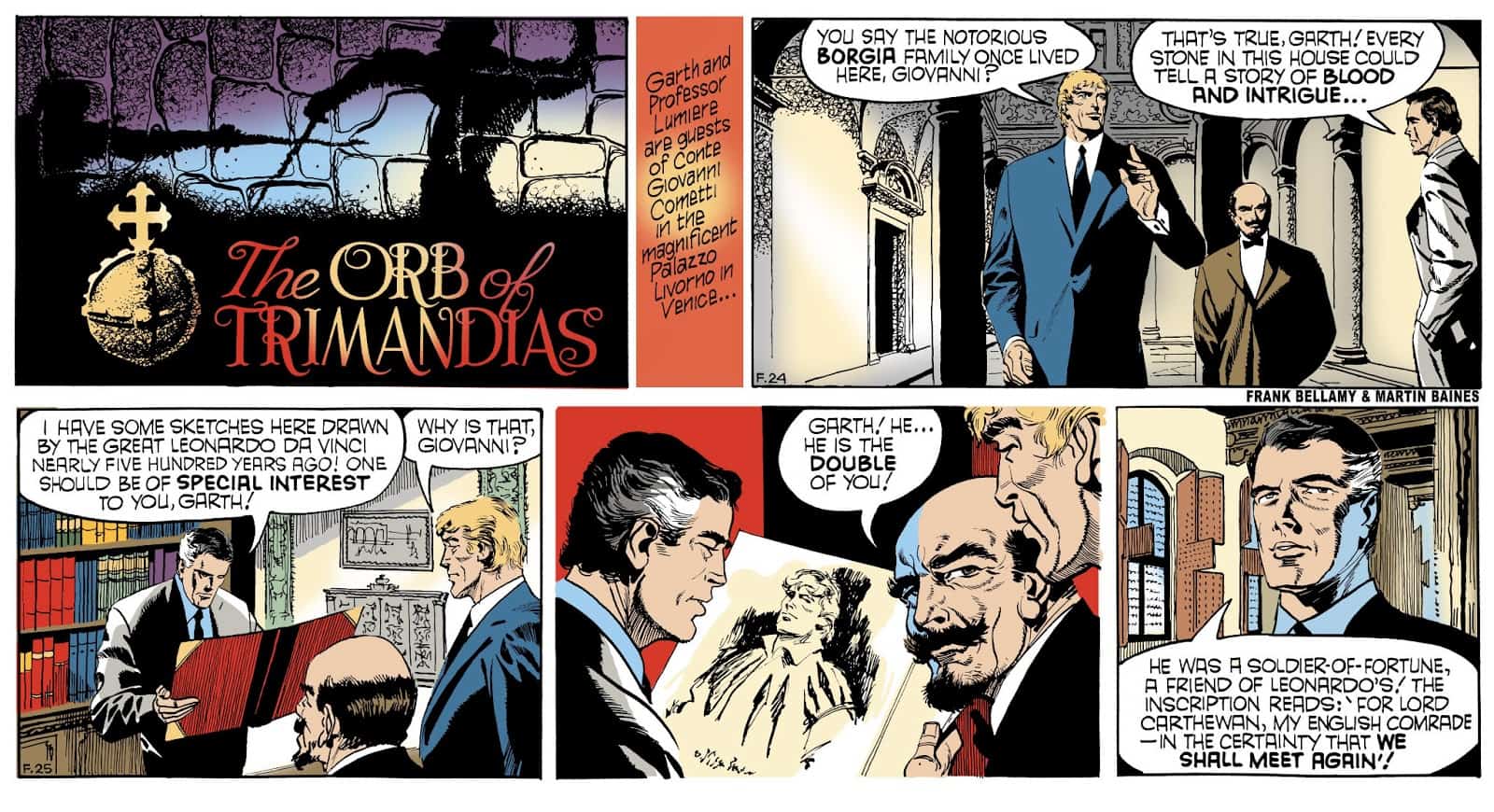
Garth was a comic strip in the British newspaper Daily Mirror from July 24, 1943, to March 22, 1997. The strip belonged to the action-adventure genre and recounted the exploits of the title character, an immensely strong hero who battled various villains throughout the world and many different chronological eras. Garth was widely syndicated throughout English-speaking countries during its long run. The 1960s Australian fast bowler Garth McKenzie was nicknamed after the comic strip hero.
Steve Dowling and Gordon Boshell were the originators of the Garth character. Dowling wanted to create a British adventure comic strip, and took inspiration from the American comic strips Superman, Flash Gordon and Terry and the Pirates. Dowling and Boshell took on 15-year-old John Allard to work on Garth, who stayed with the strip for its entire lifetime. After 59 adventures Dowling retired and handed Garth over to Allard, which he carried on until 1971 when Eagle comics‘ Dan Dare artist, Frank Bellamy, took over the art with Allard writing the scripts. Garth’s longevity had been established by Don Freeman, who created almost every basic Garth plot on which the saga was built. Peter O’Donnell, Jim Edgar and Angus Allan also wrote extensively for the strip during its decades-long existence. Philip Harbottle is a leading Garthexpert and collector of the strips, and he wrote several of the stories during the 1990s. Martin Asbury became Garth’s artist after Frank Bellamy’s death in 1976, drawing the strip and writing many of the stories until its final episode in 1997.
In 1993, Bill Storrie produced perhaps a dozen or so 60-page photocopied magazines titled The Gopherville Argus Special Edition No. 1 featuring Garth as a tribute to the writers and artists who had been involved with the strip. Most if not all Garth strips are now owned byMirror.
As of Wednesday 13 August 2008, “Garth” has reappeared on the website of the Daily Mirror, drawn by the artist Huw J. Davies. ( aka HuwJ & currently HuwJ Matsumura )
The Online Strip, was a Successful re- Visiting / Re-Imagineering of the character, Taking him back to the Pre-Steve Dowling Origins and Establishing him in a Historical Setting.
Having successfully worked in the Media Entertainment industry and Printed Media for over 3 decades ( Including Periods at Disney Warner and Fox ) Huw J believed that the Re Imagined version could easily cross from the Digital, back to the Printed medium, and Ultimately licensing to other media. This was Discussed and the future of the character in print was agreed upon. with a new ongoing Daily strip in print being Planned to run at the end of the 2nd Online story arc, King of New York. ( which also established the reasons behind the Characters Dislike for Guns)
However, due to an untimely accident involving Long standing cartoon editor Ken Layson, with who the agreement had been made things became muddied and internal politics with the Mirrorpix licensing arm of the newspaper created issues that delayed and inevitably halted this decision.
HuwJ decided to honor the characters History, and under the terms of his License re-branded the character tipping the hat to Don Freeman longtime writer of the strip by Giving Garth a Surname, the Graphic Novel Titled Captain Garth Freeman of the Armed Services and in 2010 was launched initially under British Publisher Markosia, and was a success! Selling out both at Specialist Comic Stores and Conventions, as well as Online. it was re-Published in 2013 By Pummie Productions ink, At first in its usual format and (also in 2013) with a New Cover by Spider-Man Artist and Stan Lee Collaborator Andy Tong it was repackaged with the Garth Title in Honor of the 70th Anniversary of the character with all proceeds going to Help for Heroes.
In 2015, Published again by Pummie Productions ink, the character Starred Alongside Sexton Blake, in the 1st of what is promised to be a series of Comic books, under the Captain Garth Freeman of the Armed Services title. this again sold out and if the team continues to publish the Comic it will be collected in a bumper edition after the 5th book.
HuwJ Believes that the online revamp of the character was the catalyst that got the longtime fans of the character to push for a return of the hero and what ultimately led the Newspaper and its Licensing arm to re-color the old strips and re launch them in the paper
Garth started a run of reprints in the Daily Mirror coloured by Martin Baines in the issue dated Monday 21 February 2011. and continues at present, the strip and the character are a testament to the longevity of good solid storytelling and characters with robust ideals. and looks to still have a promising future
from: wikipedia