
Anna & Mathias the final page
Anna & Mathias the final page

Anna & Mathias the final page


the story of the Amazons has never ended.
New comic-albums
Story: outisfumetti
Pencils: JCM
Ink: Luca Giorgi
Colors: Eva Castelli
Editor: Monica Ferrone
44 pages each
Soft/hard cover
full color
Language: Italian, English, French
Scheduled, spring 2017

Flash Gordon special guest Al Williamson, July 8, 2001.
During the summer of 1998 I was working on staff as a colorist at King Features Syndicate. King was gearing up to move from the building it had occupied for decades and I got a tip that a number of old files were being thrown out. I was told that if I was up for it I could go through the trash and keep whatever I wanted as the files mostly consisted of decades old paperwork and files of proof sheets from a myriad of projects/collections that spanned back for years and years.
Rooting through the dumpster I eventually came upon a a lost treasure – proof sheets of Al Williamson’s work on Flash Gordon from the old 1960’s King Comics. I could not believe my luck. Now this was around the time that Marvel was withholding artwork from Jack Kirby. That being the case I got Williamson’s contact info from our Comics Editor Tom Daning who had worked with Al two years prior, and – after making copies for myself – sent off the proof sheets.

About a week later I got a call from Al. He thanked me, then told me how all the artwork from that first issue of Flash Gordon he had drawn had been stolen years ago. He greatly appreciated receiving the package of proof sheets from out of the blue – so much so in fact that he invited me out to his studio.
continued http://www.jimkeefe.com/archives/94

Flash Gordon by John Romita.
John Romita Senior started drawing after spending a year in commercial art. His first jobs were for Stan Lee‘s Atlas group in 1949. Romita drew mostly horror and romance stories, but also several war, western and crime features for Western Publishing. After the folding of Atlas, he went to National, where he did anonymous romance stories for eight years. He then went back to Stan Lee, this time at Marvel. His first works were inking ‘Avengers’ and pencilling ‘Daredevil’ comics.
His most notable work became the ‘Amazing Spider-Man’ comic, which he did from 1966. Under Romita’s and Lee’s guidance, ‘Spider-Man’ became the quintessential antihero of the late 1960s and early 1970s. He left the ‘Spider-Man’ comic in the early 1970s, to become an art director at Marvel, working specifically in the Special Projects Department. Romita Sr. was engaged in product illustration and special designs and as Art Director for Marvel Books, the short-lived children’s book line. In 1977, he briefly did the artwork of the syndicated ‘Spider-Man’ newspaper comic. His son, John Romita Jr., is also a talented artist for Marvel.
Flash Gordon Sunday page of 1 December 2002.
Flash Gordon is the hero of a space opera adventure comic strip created by and originally drawn by Alex Raymond. First published January 7, 1934, the strip was inspired by and created to compete with the already established Buck Rogers adventure strip.
The Flash Gordon comic strip has been translated into a wide variety of media, including motion pictures, television and animated series. The latest version, a Flash Gordon television series, appeared on the Syfy channel in the United States in 2007–2008.
Alexander Gillespie “Alex” Raymond (October 2, 1909 – September 6, 1956) was an American cartoonist, best known for creating Flash Gordon for King Features in 1934. The strip was subsequently adapted into many other media, from a series of movie serials (1936–1940) to a 1970s television series and a 1980 film.
Raymond’s father encouraged his love of drawing from an early age, leading him to become an assistant illustrator in the early 1930s on strips such as Tillie the Toiler and Tim Tyler’s Luck. Towards the end of 1933, Raymond created the epic Flash Gordon science-fiction comic strip to compete with the popular Buck Rogers comic strip and, before long, Flash was the more popular strip of the two. Raymond also worked on the jungle adventure saga Jungle Jim and spy adventure Secret Agent X-9 concurrently with Flash, though his increasing workload caused him to leave Secret Agent X-9 to another artist by 1935. He left the strips in 1944 to join the Marines, saw combat in the Pacific Ocean theater in 1945 and was demobilized in 1946. Upon his return from serving during World War II, Raymond created and illustrated the much-heralded Rip Kirby, a private detective comic strip. In 1956, Raymond was killed in a car crash at the age of 46; he was survived by his wife and five children.
He became known as “the artist’s artist”[4] and his much-imitated style can be seen on the many strips he illustrated. Raymond worked from live models furnished by Manhattan’s Walter Thornton Agency, as indicated in “Modern Jules Verne,” a profile of Raymond published in the Dell Four-Color Flash Gordon #10 (1942), showing how Thornton model Patricia Quinn posed as a character in the strip.
Numerous artists have cited Raymond as an inspiration for their work, including comic artists Jack Kirby, Bob Kane, Russ Manning, and Al Williamson. George Lucas cited Raymond as a major influence for Star Wars. He was inducted into the Will Eisner Comic Book Hall of Famein 1996. Maurice Horn stated that Raymond unquestionably possessed “the most versatile talent” of all the comic strip creators. He has also described his style as “precise, clear, and incisive.” Carl Barks described Raymond as a man “who could combine craftsmanship with emotions and all the gimmicks that went into a good adventure strip.” Raymond’s influence on other cartoonists was considerable during his lifetime and did not diminish after his death.

Funerale per un fumetto in Giappone. Dopo la morte di Rikishi, uno dei protagonisti del manga Rocky Joe , nel 1970 fu organizzato un vero e proprio funerale, a cui parteciparono centinaia di persone;
Il manga è stato pubblicato dalla Kodansha dal 1968 al 1973 (in Italia dal 2002 dalla Star Comics), scritto da Asao Takamori (con lo pseudonimo di Ikki Kajiwara) e disegnato da Tetsuya Chiba.
Dal manga sono stati tratti due anime televisivi (il primo nel 1971, a manga ancora in corso, composto da 79 episodi, il secondo realizzato nel 1980 e composto da 47 episodi). I primi 12 episodi della 2ª serie sono un riassunto dell’ultima parte della prima serie, reso necessario dai quasi dieci anni intercorrenti tra le due serie.
Nel 1980 fu anche realizzato un film, Rocky Joe, l’ultimo round. Ne è stato infine fatto un adattamento live action per il cinema nel 2011 dal titolo Ashita no Joe con Tomohisa Yamashita nella parte del protagonista.
vedi anche volume 1 de Dizionario enciclopedico dei fumetti tradotti in film


Mathias special guest Festivaletteratura #34 con le tavole delle sue avventure esposte per tutto il mese di settembre nelle sale del ristorante Masseria nello storico palazzo del Massaro in piazza Broletto a Mantova.

Monica Literary Agency Opening Office in Santa Monica, fall 2016

Mathias and Anna volume 2
scheduled October 2016
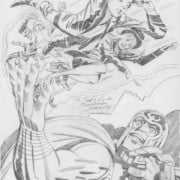
Paul Mc Cartney & the King Jack Kirby http://twomorrows.com/kirby/articles/08mcartney.html

Jack Kirby August 28, 1917 – February 6, 1994), born Jacob Kurtzberg, was an American comic book artist, writer, and editorwidely regarded as one of the medium’s major innovators and one of its most prolific and influential creators.
Kirby grew up poor in New York City, and learned to draw cartoon figures by tracing characters from comic strips and editorial cartoons. He entered the nascent comics industry in the 1930s, drawing various comics features under different pen names, including Jack Curtiss, before ultimately settling on Jack Kirby. In 1940, he and writer-editor Joe Simon created the highly successful superhero character Captain Americafor Timely Comics, predecessor of Marvel Comics. During the 1940s, Kirby, generally teamed with Simon, created numerous characters for that company and for National Comics Publications, later to become DC Comics.
https://en.wikipedia.org/wiki/Jack_Kirby
Sir James Paul McCartney, MBE (born 18 June 1942) is an English singer-songwriter, multi-instrumentalist, and composer. With John Lennon, George Harrison, and Ringo Starr, he gained worldwide fame with the rock band the Beatles, one of the most popular and influential groups in the history of pop music. His songwriting partnership with Lennon is one of the most celebrated of the 20th century. After the band’s break-up, he pursued a solo career and formed Wings with his first wife, Linda, and Denny Laine.
https://en.wikipedia.org/wiki/Paul_McCartney