Tag Archivio per: V.T. Hamlin

Xtina comic strip – who me?

Centered on the life of Xtina, in her work as assistant in a Museum, Xtina’s chronicles the daily challenges of a worker. At work, we follow xtina as she copes with friends, relationships, and the day-to-day trials of a working woman living life in the 21st century.

Xtina sophisticated comic strip?

sophisticated comic strip

The qualifying word “possibly”, above, is important because defining the qualifications for being considered a “surrealist strip” is difficult. The epithet “surrealist” can have different meanings. It has been a label applied to strips of vastly different kinds – particularly examples about dreaming, or featuring unexpected juxtapositions, but also strips about psychedelic or hyperreal consciousnesses. In terms of more scholarly taxonomies and typologies, definitions have tended to emphasise formalist qualities, such as an aesthetic that is “anti-narrative”. Also, the notion of a “first” is controversial, and dependent on context and definitions (added to which, there may have been other examples of surrealist comic strips that this writer is not aware of).

The picture is complicated by the fact that certain fine artists working in a surrealist tradition have produced sequential narratives that might be considered “comics”. Max Ernst, for example, produced his A Week of Kindnessin 1934: a “visual novel” in five booklets done in the form of a collage. It may count as the first surrealist comic, depending on definitions, though it was not “anti-narrative” and many surrealists would have derided its novelistic aspirations on the basis that the notion of the novel was bourgeois and redundant.

These caveats aside, this essay will concentrate on the intentions behind Wokker, which means looking in detail at the biographies of its creators. This approach itself is questionable, and acknowledgement is duly made to the warnings of Roland Barthes and his followers about “the death of the author” (Barthes, 1977, p.142-148). Rather, what is at stake here is a verifiable connection between Wokker and what was going on in Paris in the 1920s, and the way in which its mode of expression can be traced to the tenets of the original French surrealists.

Wokker typically appeared in stories told in four or five panels, and was designed as an open-ended series. Wokker trundles round his environment on wheels, but is no kid’s toy. Sometimes he takes on the personality of a mischief-maker, sometimes an ingénue, and sometimes a cynical observer. His frustration level is low, and he is apt to exclaim “Wokkit!” when things don’t go his way. His adventures follow a logic of their own – which sometimes means no logic at all. Created in 1966, Wokker’s publication history is complex. After its high point as a weekly strip in the Times Educational Supplement (hereafterTES), it appeared in three less well known magazine publications – Knuckleduster Funnies (1985-86), The Truth (1987-89) and The Whistler(1995-99).

Historical graphic novel seeks artist

Historical graphic novel seeks artist

Historical graphic novel, Italy, 15th century.

We love Enrico Marini‘s art but any style is accepted.

Xtina comic strip wrong way

Xtina comic strip wrong way

Centered on the life of Xtina, in her work as assistant in a Museum, Xtina’s chronicles the daily challenges of a worker. At work, we follow xtina as she copes with friends, relationships, and the day-to-day trials of a working woman living life in the 21st century.

July with Anna & Mathias

July with Anna & Mathias

Xtina fifth birthday

Xtina fifth birthday

Xtina published for five years every week. And five volumes published.

Centered on the life of Xtina, in her work as assistant in a Museum, Xtina’s chronicles the daily challenges of a worker. At work, we follow xtina as she copes with friends, relationships, and the day-to-day trials of a working woman living life in the 21st century.

Created by Monica

Distributed by outisfumetti.com

Once upon a time

Once upon a time… 

salone internazionale del libro Torino

the Reporters special book guest.

The adventures of two T.V. journalists – in the 1980s – whose jobs lead them to come up against major and minor dramas.

To give an idea of the style, their stories resemble the T. V. series Hill Street Blues and N.Y. Police Dept. Besides the story, the human side of the main characters and their interpersonal relationships are developed.

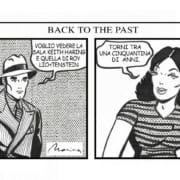
Xtina back to past

Xtina back to past

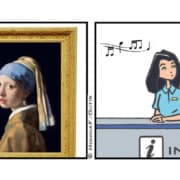
Xtina by Monica comic strip Girl with a Pearl Earring

Xtina by Monica comic strip Girl with a Pearl Earring

Girl with a Pearl Earring (Dutch: Meisje met de parel) is an oil painting by Dutch Golden Age painter Johannes Vermeer, dated c. 1665. Going by various names over the centuries, it became known by its present title towards the end of the 20th century after the large pearl earring worn by the girl portrayed there. The work has been in the collection of the Mauritshuis in The Hague since 1902 and has been the subject of various literary treatments. In 2006, the Dutch public selected it as the most beautiful painting in the Netherlands.

The painting is a tronie, the Dutch 17th-century description of a ‘head’ that was not meant to be a portrait. It depicts a European girl wearing an exotic dress, an oriental turban, and an improbably large pearl earring. In 2014, Dutch astrophysicist Vincent Icke [nl] raised doubts about the material of the earring and argued that it looks more like polished tin than pearl on the grounds of the specular reflection, the pear shape and the large size of the earring.

The work is oil on canvas and is 44.5 cm (17.5 in) high and 39 cm (15 in) wide. It is signed “IVMeer” but not dated. It is estimated to have been painted around 1665.

After the most recent restoration of the painting in 1994, the subtle colour scheme and the intimacy of the girl’s gaze toward the viewer have been greatly enhanced. During the restoration, it was discovered that the dark background, today somewhat mottled, was originally a deep enamel-like green. This effect was produced by applying a thin transparent layer of paint—a glaze—over the black background seen now. However, the two organic pigments of the green glaze, indigo and weld, have faded.

Xtina the Sunday comic strip

Xtina the Sunday comic strip

Centered on the life of Xtina, in her work as assistant in a Museum, Xtina’s chronicles the daily challenges of a worker. At work, we follow xtina as she copes with friends, relationships, and the day-to-day trials of a working woman living life in the 21st century.