Tag Archivio per: Valkyrie

flash Gordon by John Romita

Flash Gordon by John Romita.

John Romita Senior started drawing after spending a year in commercial art. His first jobs were for Stan Lee‘s Atlas group in 1949. Romita drew mostly horror and romance stories, but also several war, western and crime features for Western Publishing. After the folding of Atlas, he went to National, where he did anonymous romance stories for eight years. He then went back to Stan Lee, this time at Marvel. His first works were inking ‘Avengers’ and pencilling ‘Daredevil’ comics.

His most notable work became the ‘Amazing Spider-Man’ comic, which he did from 1966. Under Romita’s and Lee’s guidance, ‘Spider-Man’ became the quintessential antihero of the late 1960s and early 1970s. He left the ‘Spider-Man’ comic in the early 1970s, to become an art director at Marvel, working specifically in the Special Projects Department. Romita Sr. was engaged in product illustration and special designs and as Art Director for Marvel Books, the short-lived children’s book line. In 1977, he briefly did the artwork of the syndicated ‘Spider-Man’ newspaper comic. His son, John Romita Jr., is also a talented artist for Marvel.

Flash Gordon Sunday page of 1 December  2002.

Flash Gordon is the hero of a space opera adventure comic strip created by and originally drawn by Alex Raymond. First published January 7, 1934, the strip was inspired by and created to compete with the already established Buck Rogers adventure strip.

The Flash Gordon comic strip has been translated into a wide variety of media, including motion pictures, television and animated series. The latest version, Flash Gordon television series, appeared on the Syfy channel in the United States in 2007–2008.

Alexander Gillespie “Alex” Raymond (October 2, 1909 – September 6, 1956) was an American cartoonist, best known for creating Flash Gordon for King Features in 1934. The strip was subsequently adapted into many other media, from a series of movie serials (1936–1940) to a 1970s television series and a 1980 film.

Raymond’s father encouraged his love of drawing from an early age, leading him to become an assistant illustrator in the early 1930s on strips such as Tillie the Toiler and Tim Tyler’s Luck. Towards the end of 1933, Raymond created the epic Flash Gordon science-fiction comic strip to compete with the popular Buck Rogers comic strip and, before long, Flash was the more popular strip of the two. Raymond also worked on the jungle adventure saga Jungle Jim and spy adventure Secret Agent X-9 concurrently with Flash, though his increasing workload caused him to leave Secret Agent X-9 to another artist by 1935. He left the strips in 1944 to join the Marines, saw combat in the Pacific Ocean theater in 1945 and was demobilized in 1946. Upon his return from serving during World War II, Raymond created and illustrated the much-heralded Rip Kirby, a private detective comic strip. In 1956, Raymond was killed in a car crash at the age of 46; he was survived by his wife and five children.

He became known as “the artist’s artist”[4] and his much-imitated style can be seen on the many strips he illustrated. Raymond worked from live models furnished by Manhattan’s Walter Thornton Agency, as indicated in “Modern Jules Verne,” a profile of Raymond published in the Dell Four-Color Flash Gordon #10 (1942), showing how Thornton model Patricia Quinn posed as a character in the strip.

Numerous artists have cited Raymond as an inspiration for their work, including comic artists Jack KirbyBob KaneRuss Manning, and Al WilliamsonGeorge Lucas cited Raymond as a major influence for Star Wars. He was inducted into the Will Eisner Comic Book Hall of Famein 1996. Maurice Horn stated that Raymond unquestionably possessed “the most versatile talent” of all the comic strip creators. He has also described his style as “precise, clear, and incisive.” Carl Barks described Raymond as a man “who could combine craftsmanship with emotions and all the gimmicks that went into a good adventure strip.” Raymond’s influence on other cartoonists was considerable during his lifetime and did not diminish after his death.

Funerale per un fumetto

Funerale per un fumetto in Giappone. Dopo la morte di Rikishi, uno dei protagonisti del manga Rocky Joe , nel 1970 fu organizzato un vero e proprio funerale, a cui parteciparono centinaia di persone;

Il manga è stato pubblicato dalla Kodansha dal 1968 al 1973 (in Italia dal 2002 dalla Star Comics), scritto da Asao Takamori (con lo pseudonimo di Ikki Kajiwara) e disegnato da Tetsuya Chiba.

Dal manga sono stati tratti due anime televisivi (il primo nel 1971, a manga ancora in corso, composto da 79 episodi, il secondo realizzato nel 1980 e composto da 47 episodi). I primi 12 episodi della 2ª serie sono un riassunto dell’ultima parte della prima serie, reso necessario dai quasi dieci anni intercorrenti tra le due serie.

Nel 1980 fu anche realizzato un film, Rocky Joe, l’ultimo round. Ne è stato infine fatto un adattamento live action per il cinema nel 2011 dal titolo Ashita no Joe con Tomohisa Yamashita nella parte del protagonista.

vedi anche volume 1 de Dizionario enciclopedico dei fumetti tradotti in film

cx2mva_cover

Mathias special guest Festivaletteratura #34

Mathias special guest Festivaletteratura #34 con le tavole delle sue avventure esposte per tutto il mese di settembre nelle sale del  ristorante Masseria nello storico palazzo del Massaro in piazza Broletto a Mantova.

Mathias and Anna volume 2

Mathias and Anna volume 2

scheduled October 2016

Paul Mc Cartney & the King

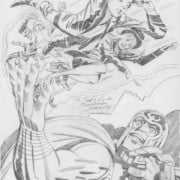
Paul Mc Cartney & the King Jack Kirby http://twomorrows.com/kirby/articles/08mcartney.html

paullindakirby

Jack Kirby August 28, 1917 – February 6, 1994), born Jacob Kurtzberg, was an American comic book artist, writer, and editorwidely regarded as one of the medium’s major innovators and one of its most prolific and influential creators.

Kirby grew up poor in New York City, and learned to draw cartoon figures by tracing characters from comic strips and editorial cartoons. He entered the nascent comics industry in the 1930s, drawing various comics features under different pen names, including Jack Curtiss, before ultimately settling on Jack Kirby. In 1940, he and writer-editor Joe Simon created the highly successful superhero character Captain Americafor Timely Comics, predecessor of Marvel Comics. During the 1940s, Kirby, generally teamed with Simon, created numerous characters for that company and for National Comics Publications, later to become DC Comics.

https://en.wikipedia.org/wiki/Jack_Kirby

Sir James Paul McCartney, MBE (born 18 June 1942) is an English singer-songwriter, multi-instrumentalist, and composer. With John Lennon, George Harrison, and Ringo Starr, he gained worldwide fame with the rock band the Beatles, one of the most popular and influential groups in the history of pop music. His songwriting partnership with Lennon is one of the most celebrated of the 20th century. After the band’s break-up, he pursued a solo career and formed Wings with his first wife, Linda, and Denny Laine.

https://en.wikipedia.org/wiki/Paul_McCartney


Flash Gordon by George Evans

Flash Gordon by special guest George R. Evans (February 5, 1920- June 22, 2001) was an American cartoonist and illustrator who worked in both comic books andcomic strips. His lifelong fascination with airplanes and the pioneers of early aviation was a constant theme in his art and stories.

Flash Gordon Sunday page of 21 January 2001.

Flash Gordon is the hero of a space opera adventure comic strip created by and originally drawn by Alex Raymond. First published January 7, 1934, the strip was inspired by and created to compete with the already established Buck Rogers adventure strip.

The Flash Gordon comic strip has been translated into a wide variety of media, including motion pictures, television and animated series. The latest version, Flash Gordon television series, appeared on the Syfy channel in the United States in 2007–2008.

Alexander Gillespie “Alex” Raymond (October 2, 1909 – September 6, 1956) was an American cartoonist, best known for creating Flash Gordon for King Features in 1934. The strip was subsequently adapted into many other media, from a series of movie serials (1936–1940) to a 1970s television series and a 1980 film.

Raymond’s father encouraged his love of drawing from an early age, leading him to become an assistant illustrator in the early 1930s on strips such as Tillie the Toiler and Tim Tyler’s Luck. Towards the end of 1933, Raymond created the epic Flash Gordon science-fiction comic strip to compete with the popular Buck Rogers comic strip and, before long, Flash was the more popular strip of the two. Raymond also worked on the jungle adventure saga Jungle Jim and spy adventure Secret Agent X-9 concurrently with Flash, though his increasing workload caused him to leave Secret Agent X-9 to another artist by 1935. He left the strips in 1944 to join the Marines, saw combat in the Pacific Ocean theater in 1945 and was demobilized in 1946. Upon his return from serving during World War II, Raymond created and illustrated the much-heralded Rip Kirby, a private detective comic strip. In 1956, Raymond was killed in a car crash at the age of 46; he was survived by his wife and five children.

He became known as “the artist’s artist”[4] and his much-imitated style can be seen on the many strips he illustrated. Raymond worked from live models furnished by Manhattan’s Walter Thornton Agency, as indicated in “Modern Jules Verne,” a profile of Raymond published in the Dell Four-Color Flash Gordon #10 (1942), showing how Thornton model Patricia Quinn posed as a character in the strip.

Numerous artists have cited Raymond as an inspiration for their work, including comic artists Jack KirbyBob KaneRuss Manning, and Al WilliamsonGeorge Lucas cited Raymond as a major influence for Star Wars. He was inducted into the Will Eisner Comic Book Hall of Famein 1996. Maurice Horn stated that Raymond unquestionably possessed “the most versatile talent” of all the comic strip creators. He has also described his style as “precise, clear, and incisive.” Carl Barks described Raymond as a man “who could combine craftsmanship with emotions and all the gimmicks that went into a good adventure strip.” Raymond’s influence on other cartoonists was considerable during his lifetime and did not diminish after his death.


Mathias & Anna episodio 22

Mathias e Anna nella nuova avventura a Venezia dal titolo “un inferno a Venezia”. Proseguono le avventure.

SERIE: Mathias

STORY/ART: Giancarlo Malagutti

GENRE: Adventure/Mystery/Thriller/Fantasy

TARGET READERSHIP: All ages, both sexes

SETTING: Well known and characteristic cities and locations in Italy

SET IN: The Present Day

STRUCTURE & TONE OF THE STORIES: The two protagonists in this series are children and, despite their superhuman potentialities, they behave as such. They always travel accompanied by an adult, they never go out late at night and wherever they stay they’re in the company of relatives. It is within this context that the storyline develops in its own way. They’re not out to put the world to rights, yet they are endowed with a strong sense of justice and they seek to do good in the face of evil.

COLLECTION: Each episode is 44 pages long and is a complete and free-standing story.

Reading them in order is recommended. In full colors.

5 episodes ready for print.

THE PROTAGONISTS:

Mathias is a blond 10 year-old. He’s knowledgeable for his age as a result of his somewhat cosmopolitan education.

Anna is a freckly 10 year-old redhead. Orphaned at an early age she has an elderly bedridden granny. Lively, intelligent and with a searching mind, she’s the one with the sense of humour and sharp one liners.

ARTIST BIO: Giancarlo Malagutti began his career in 1973 by drawing cartoons for the monthly publication Horror. He has worked alongside Renzo Barbieri and Giorgio Cavedon on several cartoons. Malagutti has drawn several one off short stories for Intrepido, Monello and Albo TV and has inked the drawings of Sergio Zaniboni for Diabolik which is where he began to write scripts. In 1981 he began freelancing for IF, working on Japanese cartoons including Princess Zaffiro, Tiger Man and Bia. In 1982 he created the series The Reporters drawn by Zaniboni for Orient Express. After having written a story line for Martin Mystère he worked as a commercial artist for some twelve years until 1994 when he resumed his work in cartoons, writing stories for Lupo Alberto, Cattivik and Mystère. Most recently he has been working on the characters of Chris Carella in collaboration with Sergio Zaniboni and both the drawings and script for Mathias www.mathias.is.it

(For a short biography visit http://www.lambiek.net/artists/m/malagutti_giancarlo.htm)

Personnages principaux:

Mathias est un normal garcon de 9 ans, blondin, mignon. fils de parents aisés qui, à cause de leur travail, lui font parcourir le vaste monde. Il a une bonne culture, malgré son âge, grâce a sa formation cosmopolite. En certaines situations, spécialement lorsque il est sous stress, il réussit à modifier (pour des petites choses) la réalité.

Anna: fillette de 9 ans, cheveux roux et lentilles. Orpheline, elle vit avec une grand-mère agée immobilisée au lit. Tres éveillée, intelligente et curieuse. C’est elle qui s’occupe de sa grand-mère. Elle vit avec l’épée de Damoclés d’être envoyée dans un orphelinat et sa grand-mère expediée à l’hospice de pauvres. très indigente, son unique revenu est la pension de sa grand-mère. Elle parâit seulement dans cet épisode mais elle peut revenir.

Texte/dessins: Giancarlo Malagutti

Genre: mystery/humour/ fantasy

Target: 8/12 ans (mais adultes aussi)

Recostitution: World

Epoque: de notre temps

Giancarlo Malagutti.

Il fait ses débuts en 1973 en réalisant les crayons de quelques histires pour la publication mensuelle Horror (Ed.Astoria). Il dessine quelques histoire sur L’Intrepido, L’Albo et Il Monello (Ed. Universo), Il encre les crayons de S.Zaniboni pour Diabolik. En 1981 il réalise  la version en bandes dessinées des séries  télévisées de Princesse Saphir, Homme Tigre, Bia. En 1982 il crée la série “The Reporters” dessinée par Sergio Zaniboni. Aprés avoir écrit pour Martin Mystére (Sergio Bonelli Editore), il se consacre au travail publicitaire et quitte pour le moment l’activité d’auteur de BD  qu’il reprend quelques années aprés en écrivant des scénarios de Lupo Alberto et Cattivik (Acme/macchia nera) et Martin Mystére.


Outis 2016 catalogue download

Monica Ferrone, Outis art director, presents the comics books scheduled for 2016

[wpdm_package id=’3104′]


French artist: Claude Jambers

Nathalie détective chérie, testo Franck Marchal, art Claude Jambers, 110 strips, France Soir, 1959

Protetto: Xtina Happy Sunday

Questo contenuto è protetto da password. Per visualizzarlo inserisci la password qui sotto.