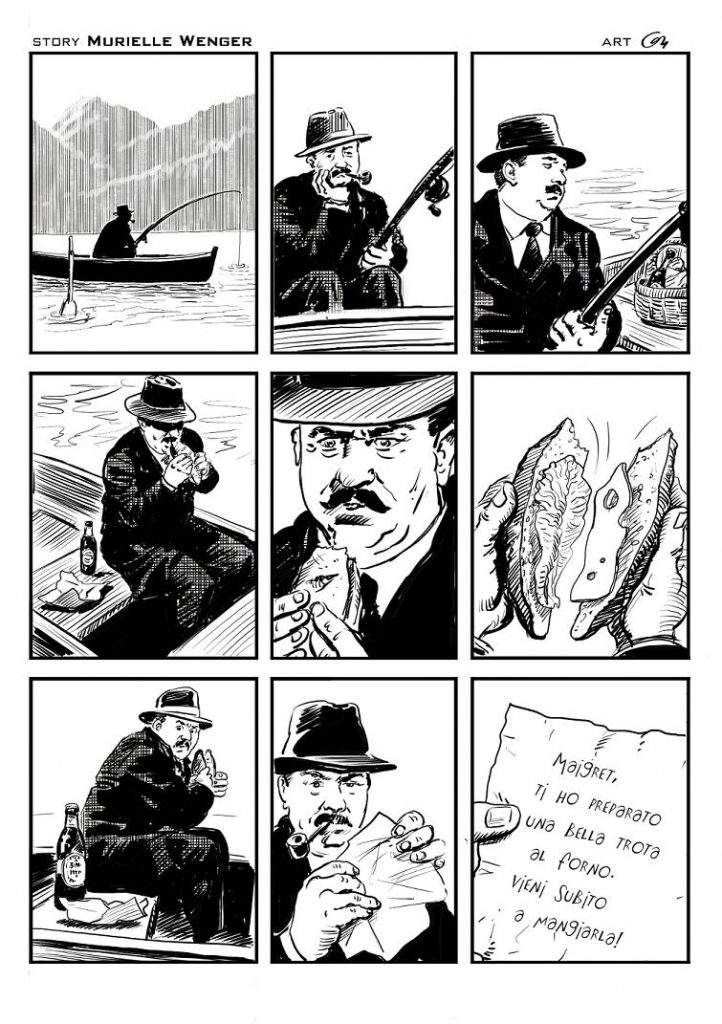
“Quand Maigret décida de partir à la pêche, ce matin-là, il emporta un panier avec un sandwich et quelques bouteilles de bière. Il s’installa au bord de la rivière et déploya sa canne. Après des heures d’attente, aucun poisson n’avait mordu. Dépité, il ouvrit son panier, but une bière, puis, comme il avait faim, il prit le sandwich. Déjà, il salivait à la pensée du bon pâté qu’il devait contenir, et il mordit dans le pain doré. Mais, quelle déception ! Dans le sandwich, il n’y avait qu’une feuille de salade et une tranche de fromage ! Maigret allait jeter le papier qui enveloppait le sandwich, quand il vit qu’il y avait un message: «Maigret, je t’ai préparé une belle truite au four. Viens vite la manger !»“
from the http://www.enquetes-de-maigret.com/
https://www.outisfumetti.com/wp-content/uploads/2016/04/poisson.jpg1071755Giancarlo Malaguttihttps://www.outisfumetti.com/wp-content/uploads/2025/09/logo-blu.pngGiancarlo Malagutti2023-11-14 09:00:002023-11-14 09:00:00Madame Maigret’s April Fool’s
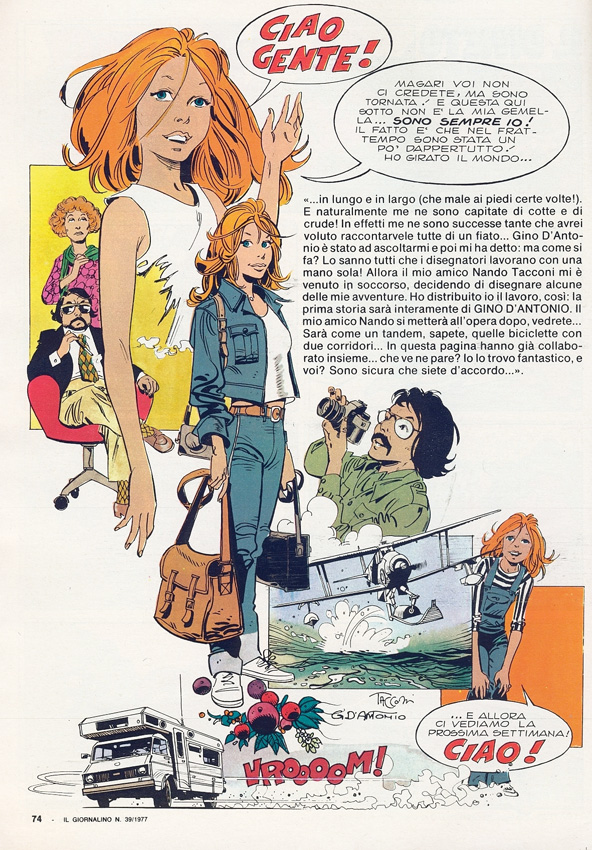
Luigi d’Antonio (16 March 1927 – 24 December 2006, Italy)
Gino d’Antonio started his professional career in 1947 with ‘Jess Dakota’ at Della Casa publishers. In 1950, he illustrated Mario Leone’s ‘Angeli della Strada’. Between 1951 and 1957, he was present at Il Vittorioso with ‘Il Trasvolatore dell Api’. In 1952, he went to work on Mondadori’s ‘Pecos Bill’ and ‘Oklahoma’ series. He was also present at Audace with some Bonelli scripted episodes of ‘El Kid’ and ‘I Tre Bill’.
In 1955, he was employed at a graphic studio directed by Piero and Roy D’Ami, where he worked for the British market. D’Antonio illustrated comics for Junior Mirror, Junior Express, Top Shot, Thriller Picture Library (‘Battler Britton’), Cowboy Picture Library (‘Gun Rule’), Fleetway Super Library and War Picture Library. He also did covers for Eagle and Boys World, and drew adaptations for traditional literature for Tell me Why and World of Wonder.
In 1967, he created ‘Il Storia del West’ for the publisher Sergio Bonelli. D’Antonio worked on this series until 1980, working together with artists like Renzo Calegari, Sergio Tarquinio and Renato Polese. In the late 1960s and early 1970s, d’Antonio cooperated on ‘La Avventure di Pace e di Guerra’ in Il Corriere dei Piccoli and with the magazine Supergulp. From 1970, he was present in Il Giornalinio with series like ‘Jim Lacy’ (scripts by Alberto Ongaro), and Susanna (artwork in cooperation with Renato Polese and Ferdinando Tacconi). He was a productive contributor to the series ‘Un Uomo, un’Avventura’, for which he provided artwork (‘L’Uomo di Zululand’, ‘L’Uomo di Iwo Jima’) and scripts illustrated by Tacconi (‘L’Uomo del Deserto’, ‘L’Uomo di Rangoon’) and Polese (‘L’Uomo di Pechino’).
from https://www.lambiek.net
https://www.outisfumetti.com/wp-content/uploads/2016/08/susanna_dantonio.jpg850592Giancarlo Malaguttihttps://www.outisfumetti.com/wp-content/uploads/2025/09/logo-blu.pngGiancarlo Malagutti2023-11-13 09:00:002023-11-13 09:00:00Susanna by Gino D’Antonio. quando un volume?
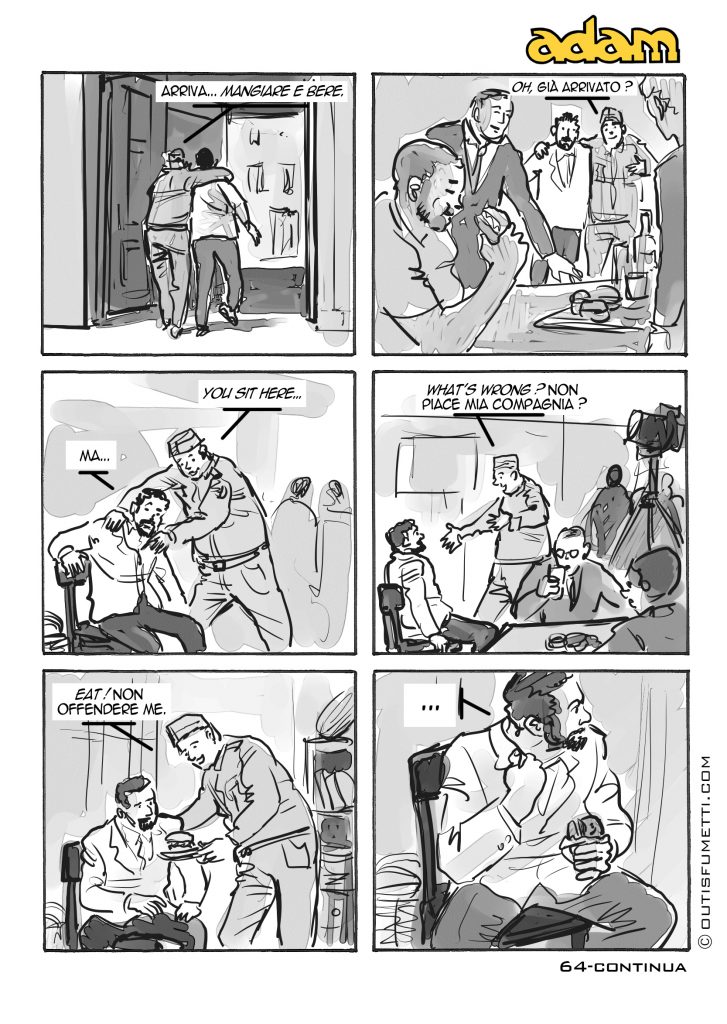
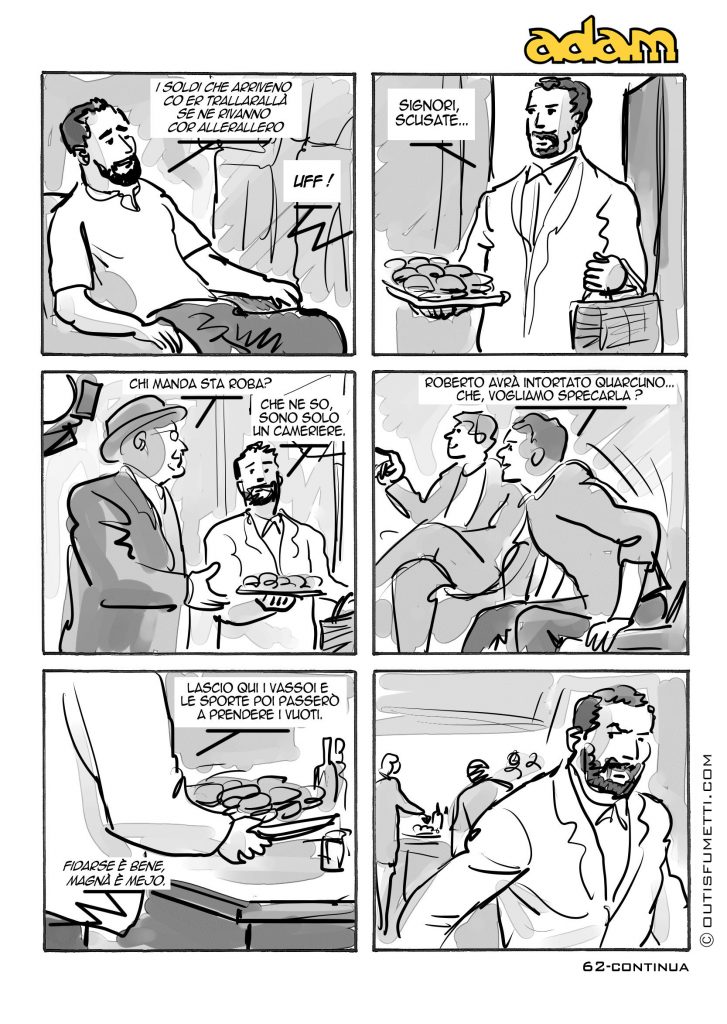
Rome, Open City (Italian: Roma città aperta, also released as Open City) is a 1945 Italian neorealist war drama film directed by Roberto Rossellini and co-written by Sergio Amidei and Federico Fellini. Set in Rome in 1944, the film follows a diverse group of characters coping under the Nazi occupation, and centers on a Resistance fighter trying to escape the city with the help of a Catholic priest. The title refers to Rome being declared an open city after 14 August 1943. It forms the first third of Rosselini’s “Neorealist Trilogy”, followed by Paisan (1946) and Germany, Year Zero (1948).
Open City is considered one of the most important and representative works of Italian neorealism, and an important stepping stone for Italian filmmaking as a whole. It was one of the first post-war Italian pictures to gain major acclaim and accolades internationally, winning the prestigious Palme d’Or at the 1946 Cannes Film Festival and being nominated for Best Adapted Screenplay Oscar at the 19th Academy Awards. It launched director Rosselini, screenwriter Fellini, and actress Anna Magnani into the international spotlight.
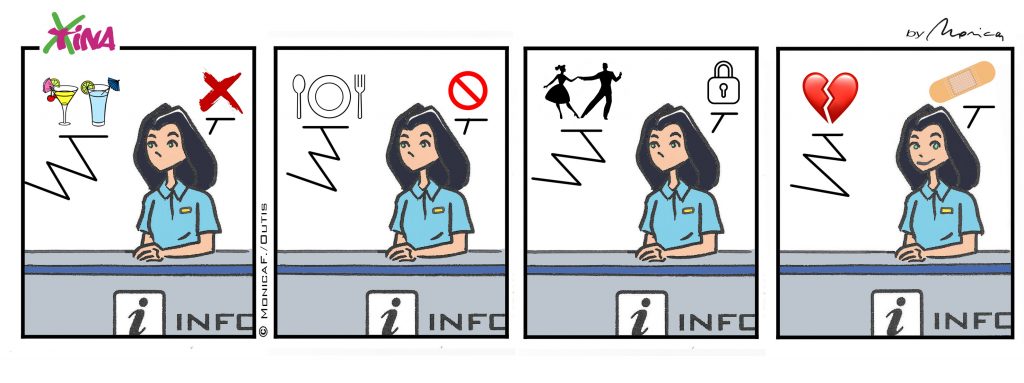
https://www.outisfumetti.com/wp-content/uploads/2023/11/Xtina-symbols-as-a-language-scaled-1.jpg9582560Giancarlo Malaguttihttps://www.outisfumetti.com/wp-content/uploads/2025/09/logo-blu.pngGiancarlo Malagutti2023-11-05 09:00:002023-11-05 09:00:00Xtina symbols as a language?
Rome, Open City (Italian: Roma città aperta, also released as Open City) is a 1945 Italian neorealist war drama film directed by Roberto Rossellini and co-written by Sergio Amidei and Federico Fellini. Set in Rome in 1944, the film follows a diverse group of characters coping under the Nazi occupation, and centers on a Resistance fighter trying to escape the city with the help of a Catholic priest. The title refers to Rome being declared an open city after 14 August 1943. It forms the first third of Rosselini’s “Neorealist Trilogy”, followed by Paisan (1946) and Germany, Year Zero (1948).
Open City is considered one of the most important and representative works of Italian neorealism, and an important stepping stone for Italian filmmaking as a whole. It was one of the first post-war Italian pictures to gain major acclaim and accolades internationally, winning the prestigious Palme d’Or at the 1946 Cannes Film Festival and being nominated for Best Adapted Screenplay Oscar at the 19th Academy Awards. It launched director Rosselini, screenwriter Fellini, and actress Anna Magnani into the international spotlight.
Rome, Open City (Italian: Roma città aperta, also released as Open City) is a 1945 Italian neorealist war drama film directed by Roberto Rossellini and co-written by Sergio Amidei and Federico Fellini. Set in Rome in 1944, the film follows a diverse group of characters coping under the Nazi occupation, and centers on a Resistance fighter trying to escape the city with the help of a Catholic priest. The title refers to Rome being declared an open city after 14 August 1943. It forms the first third of Rosselini’s “Neorealist Trilogy”, followed by Paisan (1946) and Germany, Year Zero (1948).
Open City is considered one of the most important and representative works of Italian neorealism, and an important stepping stone for Italian filmmaking as a whole. It was one of the first post-war Italian pictures to gain major acclaim and accolades internationally, winning the prestigious Palme d’Or at the 1946 Cannes Film Festival and being nominated for Best Adapted Screenplay Oscar at the 19th Academy Awards. It launched director Rosselini, screenwriter Fellini, and actress Anna Magnani into the international spotlight.
https://www.outisfumetti.com/wp-content/uploads/2023/10/Adam‘s-Rome-Open-City-War-Love-episode-63ENG.jpg23471667Giancarlo Malaguttihttps://www.outisfumetti.com/wp-content/uploads/2025/09/logo-blu.pngGiancarlo Malagutti2023-10-28 09:00:002023-10-28 09:00:00Adam‘s Rome Open City War & Love episode 63
Rome, Open City (Italian: Roma città aperta, also released as Open City) is a 1945 Italian neorealist war drama film directed by Roberto Rossellini and co-written by Sergio Amidei and Federico Fellini. Set in Rome in 1944, the film follows a diverse group of characters coping under the Nazi occupation, and centers on a Resistance fighter trying to escape the city with the help of a Catholic priest. The title refers to Rome being declared an open city after 14 August 1943. It forms the first third of Rosselini’s “Neorealist Trilogy”, followed by Paisan (1946) and Germany, Year Zero (1948).
Open City is considered one of the most important and representative works of Italian neorealism, and an important stepping stone for Italian filmmaking as a whole. It was one of the first post-war Italian pictures to gain major acclaim and accolades internationally, winning the prestigious Palme d’Or at the 1946 Cannes Film Festival and being nominated for Best Adapted Screenplay Oscar at the 19th Academy Awards. It launched director Rosselini, screenwriter Fellini, and actress Anna Magnani into the international spotlight.
Rome, Open City (Italian: Roma città aperta, also released as Open City) is a 1945 Italian neorealist war drama film directed by Roberto Rossellini and co-written by Sergio Amidei and Federico Fellini. Set in Rome in 1944, the film follows a diverse group of characters coping under the Nazi occupation, and centers on a Resistance fighter trying to escape the city with the help of a Catholic priest. The title refers to Rome being declared an open city after 14 August 1943. It forms the first third of Rosselini’s “Neorealist Trilogy”, followed by Paisan (1946) and Germany, Year Zero (1948).
Open City is considered one of the most important and representative works of Italian neorealism, and an important stepping stone for Italian filmmaking as a whole. It was one of the first post-war Italian pictures to gain major acclaim and accolades internationally, winning the prestigious Palme d’Or at the 1946 Cannes Film Festival and being nominated for Best Adapted Screenplay Oscar at the 19th Academy Awards. It launched director Rosselini, screenwriter Fellini, and actress Anna Magnani into the international spotlight.
Questo sito o gli strumenti terzi da questo utilizzati si avvalgono di cookie necessari al funzionamento ed utili alle finalità illustrate nella cookie policy. Se vuoi saperne di più o negare il consenso a tutti o ad alcuni cookie, consulta la cookie policy. Chiudendo questo banner, scorrendo questa pagina, cliccando su un link o proseguendo la navigazione in altra maniera, acconsenti all’uso dei cookie.
Potremmo richiedere che i cookie siano attivi sul tuo dispositivo. Utilizziamo i cookie per farci sapere quando visitate i nostri siti web, come interagite con noi, per arricchire la vostra esperienza utente e per personalizzare il vostro rapporto con il nostro sito web.
Clicca sulle diverse rubriche delle categorie per saperne di più. Puoi anche modificare alcune delle tue preferenze. Tieni presente che il blocco di alcuni tipi di cookie potrebbe influire sulla tua esperienza sui nostri siti Web e sui servizi che siamo in grado di offrire.
Cookie essenziali del sito Web
Questi cookie sono strettamente necessari per fornirvi i servizi disponibili attraverso il nostro sito web e per utilizzare alcune delle sue caratteristiche.
Poiché questi cookie sono strettamente necessari per fornire il sito web, rifiutarli avrà un impatto come il nostro sito funziona. È sempre possibile bloccare o eliminare i cookie cambiando le impostazioni del browser e bloccando forzatamente tutti i cookie di questo sito. Ma questo ti chiederà sempre di accettare/rifiutare i cookie quando rivisiti il nostro sito.
Rispettiamo pienamente se si desidera rifiutare i cookie, ma per evitare di chiedervi gentilmente più e più volte di permettere di memorizzare i cookie per questo. L’utente è libero di rinunciare in qualsiasi momento o optare per altri cookie per ottenere un’esperienza migliore. Se rifiuti i cookie, rimuoveremo tutti i cookie impostati nel nostro dominio.
Vi forniamo un elenco dei cookie memorizzati sul vostro computer nel nostro dominio in modo che possiate controllare cosa abbiamo memorizzato. Per motivi di sicurezza non siamo in grado di mostrare o modificare i cookie di altri domini. Puoi controllarli nelle impostazioni di sicurezza del tuo browser.
Altri servizi esterni
Utilizziamo anche diversi servizi esterni come Google Webfonts, Google Maps e fornitori esterni di video. Poiché questi fornitori possono raccogliere dati personali come il tuo indirizzo IP, ti permettiamo di bloccarli qui. Si prega di notare che questo potrebbe ridurre notevolmente la funzionalità e l’aspetto del nostro sito. Le modifiche avranno effetto una volta ricaricata la pagina.
Google Fonts:
Impostazioni Google di Enfold:
Cerca impostazioni:
Vimeo and Youtube video embeds:
Privacy Policy
Puoi leggere i nostri cookie e le nostre impostazioni sulla privacy in dettaglio nella nostra pagina sulla privacy.