
New comics books and graphic novels
New comics books and graphic novels
from Outisfumetti archives

New comics books and graphic novels
from Outisfumetti archives

Xtina fifth birthday
Xtina published for five years every week. And five volumes published.
Centered on the life of Xtina, in her work as assistant in a Museum, Xtina’s chronicles the daily challenges of a worker. At work, we follow xtina as she copes with friends, relationships, and the day-to-day trials of a working woman living life in the 21st century.
Created by Monica
Distributed by outisfumetti.com

Once upon a time…
salone internazionale del libro Torino
the Reporters special book guest.
The adventures of two T.V. journalists – in the 1980s – whose jobs lead them to come up against major and minor dramas.

To give an idea of the style, their stories resemble the T. V. series Hill Street Blues and N.Y. Police Dept. Besides the story, the human side of the main characters and their interpersonal relationships are developed.

Blek #100 with giant poster art Manlio Truscia
Il Grande Blek is an Italian western comic book, first published in Italy on October 3, 1954 by Editoriale Dardo. Blek was written and illustrated by Giovanni Sinchetto, Dario Guzzon and Pietro Sartoris, also known as trio EsseGesse.
Blek is the leader of a group of trappers during the American Revolutionary War, who fight against the cruel Redcoats, the symbol of British colonialist oppression. Blek’s best friends and allies are his stepson Roddy Lassiter and Professor Cornelius Occultis. Although not present in every episode, lawyer Connoly, the leader of American revolutionaries in Boston, is another prominent character. Benjamin Franklin also made occasional
In Italy
The prototype of the character was published in another comic called Il Piccolo Trapper in 1953, inspired by the works of Fenimore Cooper and Zane Grey. The blonde giant appeared a year later. From 1954 to 1967, 654 strips were published in the Collana Araldo series. In its heyday, the strip boasted a weekly circulation of 400,000. However, the authors moved on to create Comandante Mark after a financial disagreement with the original publisher in 1965.
In addition to Italy, Blek was reprinted in other countries such as Greece (as ΜΠΛΕΚ), Turkey (as Teksas, Çelik Blek), France (as Blek le Roc), and former Yugoslavia (as Veliki Blek). The Slovenian national minority in Italy was introduced to Blek in Slovenian language in 1959 (as Silni Tom, meaning Tough Tom); Slovenian translation was changed to Veliki Blek in 1990s. In Scandinavia he was called Davy Crockett, although he has nothing to do with the historical figure.
In France
Carlo Cedroni, Nicola Del Principe and many others continued the production for Éditions Lug, while the list of French authors included Jean-Yves Mitton and André Amouriq. The title peaked at 300,000 copies. Blek also received a revamped origin; writer Marcel Navarro revealed “Blek” means “Golden Hair” in the language of Native Americans, but that he was born Yannick Leroc in Saint-Malo, France on November 27, 1749.
In Yugoslavia
In former Yugoslavia, Blek was published in the Lunov magnus strip and Strip zabavnik series. The character reached the print run of 100,000, so in 1978 the local publisher (Dnevnik from Novi Sad) decided to produce its own licensed material, colloquially known as YU Blek. The writers were Petar Aladžić, Predrag Ivanović, Miodrag Milanović , Ivica Mitrović and Svetozar Obradović. The list of artists included Stevan Brajdić, Milorad Žarić, Miodrag Ivanović, Predrag Ivanović, D. Ivković, Branislav Kerac, Bojan Kerzan, Pavel Koza, Vladimir Krstić, Spasoje Kulauzov, Marinko Lebović, B. Ljubičić, Stevo Maslek, Nikola Maslovara, Radič Mijatović, Željko Mitrović, Ahmet Muminović, Slavko Pejak, Dušan Pivac, Branko Plavšić, Zdravko Popović, Sibin Slavković (pen name “S. Žunjević”), Ljubomir Filipov and Adam Čurdinjaković. More than 70 episodes were produced, including a sticker album.

Ricordi pubblici e privati…raccolti a fianco.
Luglio 1975. Un caldo pomeriggio d’estate. Come consuetudine, mi fermo all’edicola in cerca di novità. Erano anni nei quali usciva molta roba buona. Non ristampe di ristampe come oggi. Nuovi albi, nuovi personaggi, riviste generaliste, ecc. Non tutti dei capolavori ma avercene oggi. In un angolo tra le varie testate erotiche, probabilmente messo li più per il formato che per il presunto contenuto una copertina salta agli occhi. Presunto in quando l’albo è, stranamente, cellofanato. Non lo erano nemmeno gli erotici più spinti. Avrei saputo anni dopo il perché. La mano che ha realizzato quella copertina è indubbiamente quella di Magnus. Non c’è la sua firma (un brand allora) ma uno strano ideogramma. La sua firma sarebbe comparsa ancora per qualche mese su Alan Ford. La curiosità è forte. Decido, pur un tantino dubbioso, di spendere le 250. Scarto e… sì, è LUI. Molto diverso, molto più avanti, più maturo di tutto quello che realizzato fino ad allora. La pur embrionale linea chiara al posto del secco bianco e nero all’inizio è un po’ spiazzante, la storia è decisamente molto buona cattura. Una scena, per chi fa sempre disegni veloci senza tempo per sottigliezze e/o sfumature, mi colpisce. Pagina 40. Unknow si piega per scostare un ramo d’albero. Per disegnarla bisogna averci pensato. E’ una piccola cosa ma chi, come anche lui, macina tavole su tavole non ha tempo per pensarci. Quaranta anni dopo quell’immagine è ancora nel mio database cerebrale e ne esce una citazione in una storiellina per bambini: Anna, Mathias al Gran Premio Nuvolari.

Born today Hugo Pratt (15 June 1927 – 20 August 1995, Italy)
At an early age, Hugo Pratt got to see a lot of the world as he moved with his parents, first to Venice, then to Ethiopia, then back to Italy. In 1945, he met Mario Faustinelli, with whom he created his first comic book, ‘Asso di Picche’. He became part of what some call the Venice group, an association of writers and artists, such as Alberto Ongaro, Paolo Campani, Mario Faustinelli and Dino Battaglia. With them, he worked on several series for the comic Asso di Picche, including the title comic, ‘Ray e Roy’, ‘Silver-Pan’, ‘Indian River’ and ‘April e il Fantasma’. Finding few opportunities for comic artists in post-war Italy, Pratt, Ongaro and Mario Faustinelli moved to Argentina after an invitation by the publisher Cesar Civita of Editorial Abril.
During his stay in Argentina, he created some of his most important comics, such as ‘Sgt. Kirk’, ‘Ernie Pike’, ‘Anna della Jungla’, ‘Wheeling’ and many others. His first Argentine work was ‘Ray Kitt’, which appeared in the magazine Salgari in 1949. He got associated with writer Hector German Oesterheld, with whom he created ‘Sgt. Kirk’ in Misterix and with whom he worked at the publishing house Ediciones Frontera. The Groupe of Venice was re-assembled in Buenos Aires, and produced a great many comics for the magazines Hora Cero and Frontera. In cooperation with Oesterheld, Pratt produced series like ‘Ticonderoga’, ‘Ernie Pike’, ‘Lord Crack’ and ‘Lobo Conrad’. In addition, he made his ‘Ann y Dan’ (‘Ann de la Jungle’) in Supertotem with his own scripts. For a while, he taught at the Pan-American Art School in San Paolo, Brazil.
In 1959, he left Argentina for London and started working for the British Fleetway group through the agency of Roy d’Ami. He contributed to War Picture Library, War at Sea Picture Library and Battle Picture Library. A year later, he moved to Ireland. In 1964, Hugo Pratt was working in London for the Daily Mirror and the Sunday Pictoral. Briefly back in Argentina, he was editor for magazine Misterix, for which he created the series ‘Capitan Cormorant’ and ‘Wheeling’. In 1965, he moved back to Italy, where he worked for the Corriere dei Piccolo in Milan, illustrating series like ‘Billy James’, ‘Le Legende Indiane’, ‘L’Epopa dell’America’, ‘Sinbad il Marino’, ‘L’Odissea’, ‘Kiwi il Figlio della Giungla and many others, mostly with scripts by Milo Milani.
Two years later, he founded his own monthly Sgt. Kirk. For this, he wrote and drew ‘Luck Star O’Hara’ and ‘Gli Scorpioni del Deserto’, as well as ‘Una Ballata del Mare Salato’, a brooding tale about the South Seas, in which a character was featured who would later become the famous Corto Maltese, Pratt’s most popular creation, whose stories appeared in the French magazine Pif Gadget from 1970. The similarities between Pratt and his travelling protagonist are so striking, that they inspired Alberto Ongaro to write a book on the subject. Besides continuing his work on the ‘Corto Maltese’ series, Pratt created a number of independent comic series during the last twenty years of his life, such as ‘Cato Zulu’, ‘West of Eden’, ‘Saint-Exupéry: the Last Flight’ and ‘Jesuit Joe’. In 1991, he wrote the script for ‘The Gaucho’, which was illustrated by Milo Manara. In the summer of 1995, Hugo Pratt died of cancer at his home in Lausanne, Switzerland.
Hugo Pratt is considered to be one of the greatest among comic artists for his versatile fantasy and use of graphic freedom, and the combination of these factors resulted in very strange stories. In his tales, reality can change into dream and vice-versa, and in this way he took his readers into the strangest lands and even through time. He is thought to be one of the first comic artists to mix literature with adventure. Hugo Pratt has been a great inspiration to comic artists all over the world. In 2002 a full animated feature film was made called ‘Corto Maltese: La cour secrète des Arcanes’ (2002).
In 1999 the French newspaper Le Monde compiled a list with 100 Books of the Century they considered to be essential reading. The ‘Corto Maltese’ album ‘Ballad of the Salt Sea’ ended at 62th place, as one of the few comics in that list. On 24 October 2007 a statue of Corto Maltese, designed by Luc and Livio Benedetti, was erected in Grandvaux, Switzerland. On 4 July 2008, the men erected another statue of Croto and placed it on the footbridge in Angoulême, France. Despite not being a Belgian character ‘Corto Maltese’ also received his own comic book mural in Brussels, as part of the Brussels’ Comic Book Route. Since 28 October 2009 it can be viewed in the Quai des Péniches / Akenkaai, near the local harbour.
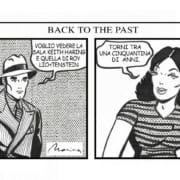
Xtina back to past
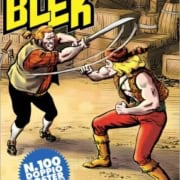
Blek le roc100 & 2 Posters Art: Manlio Truscia
Blek, dit Blek le Roc, est un personnage de bande dessinée créé en Italie (ou fumetti) par le studio EsseGesse composé de Pietro Sartoris, Dario Guzzon, Giovanni Sinchetto en 1954 pour l’éditeur italien Dardo sous le nom de Il Grande Blek. La bande dessinée Blek le Roc est publiée a strisce (format à l’italienne) durant 650 fascicules jusqu’en 1967 avant qu’un litige oppose les auteurs à l’éditeur. Le trio décide alors d’abandonner le personnage pour en créer un autre similaire chez un concurrent. Ce sera Capt’ain Swing (ou Comandante Mark en Italie).

Many Adam under the sky
Adam is a figure in the Book of Genesis in the Hebrew Bible, from where he was adopted into Christian belief and the Quran. According to the creation myth of the Abrahamic religions, he was the first man. In both Genesis and Quran, Adam and his wife were expelled from a Garden of Eden for eating the fruit of the tree of knowledge of good and evil.
Various forms of creationism and biblical literalism consider Adam to be a historical person. Scientific evidence does not support the idea that the entire human population descends from a single man.
The word adam is also used in the Bible as a pronoun, individually as “a human” and in a collective sense as “mankind”. Biblical Adam (man, mankind) is created from adamah (earth), and Genesis 1–8 makes considerable play of the bond between them, for Adam is estranged from the earth through his disobedience.
How does a scriptwriter react to the misadventures he has always only imagined?
Adam, who has fled from his country (in our comic it is for political reasons, but it can be changed), has to learn how to survive in a primitive and hostile environment.
The classic fugitive scenario but, being a normal person, he has to deal with situations by drawing on to his cultural background (films/books/comics) rather than using muscle power.
Story: Giancarlo Malagutti
Art: Manlio Truscia

comics bad language