Tag Archivio per: William Morris Agency

July Xtina last strip

Xtina the last strip for July, is a comic-strip created by Monica

Xtina comic strips are centered on the life of Xtina in her work as assistant in a Museum. Xtina’s chronicles the daily challenges of a worker. At work, we follow Xtina as she copes with friends, relationships, and the day-to-day trials of a working woman living life in the 21st century.

Xtina’s comic-strip, subject, Art and Script-writer:

Dalla presentazione di Gianfranco Goria:

Eccola qui, Monica (figlia d’arte, mi dicono, con una naturale propensione, si direbbe, per le strip statunitensi, così efficaci, così difficili da fare bene). Eccola col suo tratto essenziale e pulito (perfetto per la rete, ma pubblicato sulla carta stampata), da leggere con leggerezza per ricavarne un sorriso e qualche pensiero intelligente.

Al momento l’autrice ha appena qualche anno in più della protagonista della sua striscia, XTINA, lavoratrice museuale diciannovenne ingabbiata in quel banco informazioni che, se da un lato la rende libera e autonoma, dall’altro la costringe a fuggire costantemente con la fantasia (da ex impiegato di concetto,  come la capisco…). L’arte arriva fino a quel banco, anche se magari non nel modo che la ragazza avrebbe voluto, ma non è l’unica a desiderare di più per la propria vita: c’è anche, per dire, un giovane in divisa che, per ora, sembra davvero fare tanta fatica a trovare quel che cerca… Ma, no, non ci si deve rassegnare! Oh, no. C’è tutta una vita davanti! In fondo “un anno nuovo è un foglio bianco tutto da scrivere”… Oh… cioé… insomma… cestini permettendo.

Immagino le sue giovani lettrici, immedesimarsi con estrema facilità. Immagino i padri delle sue lettrici, riconoscere (e forse scoprire) le proprie figlie. Immagino altre strisce e altre ancora che verranno e mi chiedo se XTINA crescerà anche lei, nel suo mondo a strisce, e troverà le cose belle della vita che la attendono, appena un poco più in là.

Soap Comic Strips Apartment 3-G

Apartment 3-G was an American newspaper soap opera comic strip about a trio of career women who share the eponymous Apartment 3-G in Manhattan. Created by Nicholas P. Dallis with art by Alex Kotzky, the strip began May 8, 1961, initially distributed by the Publishers Syndicate, which later merged with King Features Syndicate.

The strip went through several changes of writers and artists over its 54-year run, finally ending on November 22, 2015.

Alex Kotzky

(11 September 1923 – 26 September 1996, USA)

In early 1951, Kotzky started out doing storyboards for the Johnstone and Cushing advertisement agency, while also working on the Ford Motor Company and Dodge auto accounts. In the mid-fifties he began freelancing, creating medical illustrations for magazines and ghosting newspaper strips like Juliet JonesBig Ben Bolt, and Steve Canyon. He also drew for Phillip Morris the very popular Duke Handy Sunday cigarette ads at this time.

When Harold Anderson, head of the Publishers Newspaper Syndicate, heard of a new strip idea from psychiatrist and writer Nick Dallis, he quickly contacted Alex about drawing the upcoming feature. The newspaper strip Apartment 3-G developed from their well matched collaboration and debuted with a daily and Sunday format on May 8, 1961. The story detailed the adventures of three beautiful career women who shared an high-rise apartment in New York City. Lu Ann Powers was the spunky school teacher; Tommie Thompson a brainy registered nurse; and Margo Magee, a knock-out executive secretary. As well as the varied look of the ladies, usually the three have different attitudes to match there respective hair colors! To round off the 3-G trio we have their neighbor, Professor Pappagoras, a local Greek college professor who helps the girls as father figure, advisor, friend, and some time protector. This remarkably fresh strip for the day was one of the first realistic portrayals of working women in the comic pages. The intelligent storylinesconcentrated on the characters and their different personalities, making the strip more realistic and enjoyable to read than many of their contemporary story strips. Better writing, coupled withKotzky’s slick illustrative style and delightful portrayal of the women, made the feature a fan favorite world wide.

the Sunday of Xtina comic-strip

the Sunday of Xtina is a comic-strip created by Monica

Xtina comic strips are centered on the life of Xtina in her work as assistant in a Museum. Xtina’s chronicles the daily challenges of a worker. At work, we follow Xtina as she copes with friends, relationships, and the day-to-day trials of a working woman living life in the 21st century.

Xtina’s comic-strip, subject, Art and Script-writer:

Dalla presentazione di Gianfranco Goria:

Eccola qui, Monica (figlia d’arte, mi dicono, con una naturale propensione, si direbbe, per le strip statunitensi, così efficaci, così difficili da fare bene). Eccola col suo tratto essenziale e pulito (perfetto per la rete, ma pubblicato sulla carta stampata), da leggere con leggerezza per ricavarne un sorriso e qualche pensiero intelligente.

Al momento l’autrice ha appena qualche anno in più della protagonista della sua striscia, XTINA, lavoratrice museuale diciannovenne ingabbiata in quel banco informazioni che, se da un lato la rende libera e autonoma, dall’altro la costringe a fuggire costantemente con la fantasia (da ex impiegato di concetto,  come la capisco…). L’arte arriva fino a quel banco, anche se magari non nel modo che la ragazza avrebbe voluto, ma non è l’unica a desiderare di più per la propria vita: c’è anche, per dire, un giovane in divisa che, per ora, sembra davvero fare tanta fatica a trovare quel che cerca… Ma, no, non ci si deve rassegnare! Oh, no. C’è tutta una vita davanti! In fondo “un anno nuovo è un foglio bianco tutto da scrivere”… Oh… cioé… insomma… cestini permettendo.

Immagino le sue giovani lettrici, immedesimarsi con estrema facilità. Immagino i padri delle sue lettrici, riconoscere (e forse scoprire) le proprie figlie. Immagino altre strisce e altre ancora che verranno e mi chiedo se XTINA crescerà anche lei, nel suo mondo a strisce, e troverà le cose belle della vita che la attendono, appena un poco più in là.

Gerald Norton or Judd Saxon?

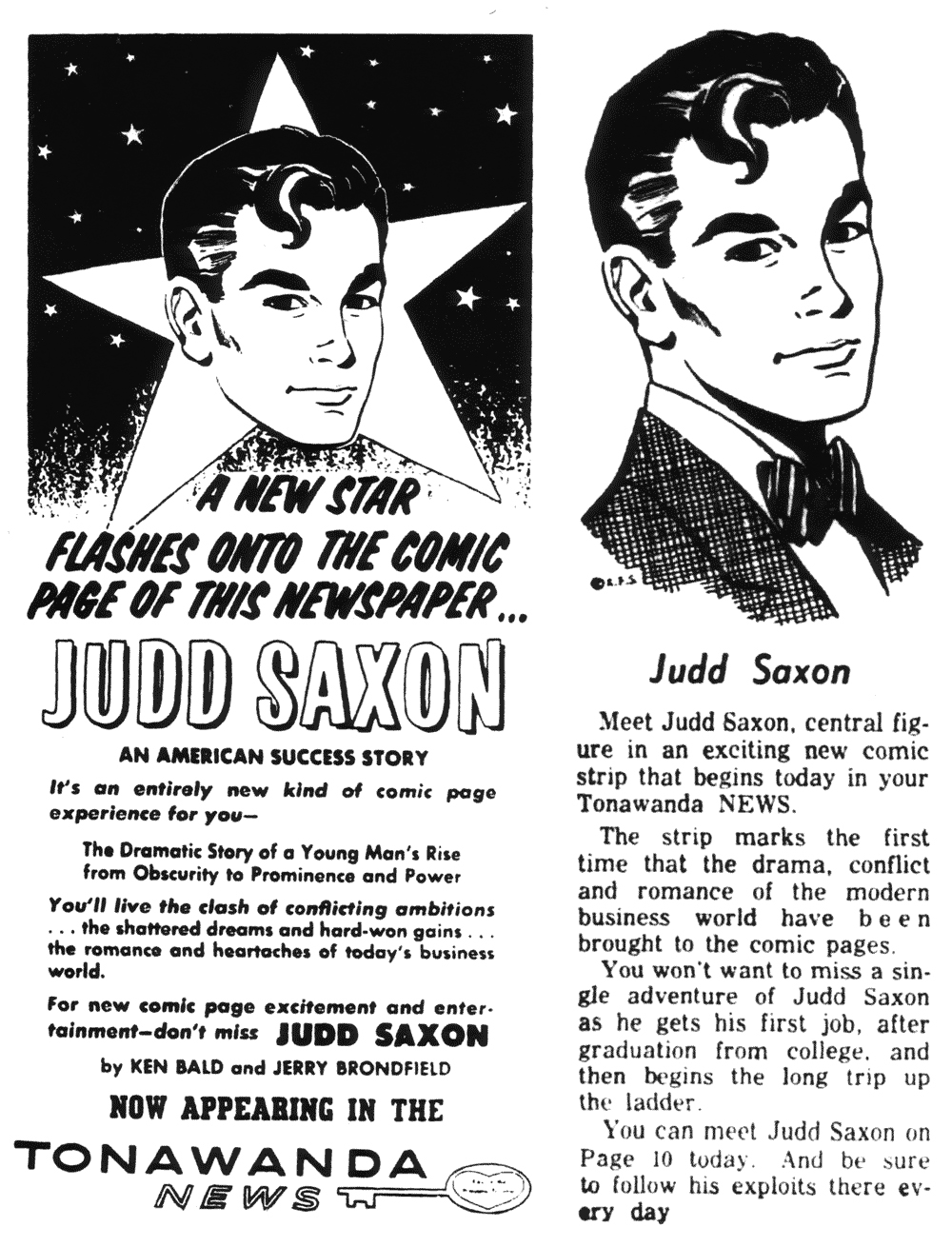
The name of the protagonist  Judd Saxon – and consequently the strip –  was changed in Gerald Norton” in France-Soir newspaper, in the late 1950s, then a monthly pocket Edi-Europe from 1964.

judd_saxon

JUDD SAXON, art   Ken Bald  57-61 -wr   Jerry Brondfield  57-61

Soap Opera was a term coined about 1940 to describe sentimental radio serials promoted to ‘the millions’ by sponsors of soap, coffee, cleanser and personal deodorant. The soaps were nothing startlingly new or original — they had their genesis in the early nineteenth century in stage melodrama and penny parts serials. Thomas Peckett Prest serialized Fatherless Fanny; or, the Mysterious Orphan (1841), in Reynolds’s Miscellany James Malcolm Rymer serialized The Divorce, a Story of Fashionable Life (1859), and George Biggs’ Family Herald (1843) offered weekly serials almost exclusively tailored to women. 

Comic strip soap opera’s heroes and heroines were solidly white middle class supporters of the status quo. The villains were not of the horrid Dick Tracy sort, like Mumbles or The Mole, rather they were mostly indistinguishable from the middle class heroes. Jane Arden’s handsome villains sometimes sported an identifying moustache, occasionally a crooked nose, but usually they resembled that clean-cut boy next door.

cont,d in Yesterday’s Papers


Conchy strips by James Childress

Conchy comicstrips by James Childress was a critically acclaimed but only modestly successful American comic strip that ran from 1970 to 1977. Set on a desert island with a group of beachcombers as the main characters, the strip addressed serious issues of its time.

James Childress (April 13, 1941-January 22, 1977) created Conchy in the early 1960s as an homage to his love of beachcombing. By 1962, Childress was pitching the strip to syndicates with no results. Eventually, he started marketing it directly to newspapers under the business name Corinthian Features. Through this, Conchy began its newspaper run on March 2, 1970.

By 1974, Conchy was appearing in 26 papers, finally attracting a syndicate’s interest, from Field Enterprises, who signed Childress up that year. His client list increased to over 150 papers.

The daily run ended on February 5, 1977, and the last Sunday strip was published March 13, 1977. (Sunday)


from wikipedia


Xtina Sunday comic-strip

Xtina sunday comic strips are centered on the life of Xtina in her work as assistant in a Museum. Xtina’s chronicles the daily challenges of a worker. At work, we follow Xtina as she copes with friends, relationships, and the day-to-day trials of a working woman living life in the 21st century.

Xtina’s comic-strip, subject, Art and Script-writer:

Dalla presentazione di Gianfranco Goria:

Eccola qui, Monica (figlia d’arte, mi dicono, con una naturale propensione, si direbbe, per le strip statunitensi, così efficaci, così difficili da fare bene). Eccola col suo tratto essenziale e pulito (perfetto per la rete, ma pubblicato sulla carta stampata), da leggere con leggerezza per ricavarne un sorriso e qualche pensiero intelligente.

Al momento l’autrice ha appena qualche anno in più della protagonista della sua striscia, XTINA, lavoratrice museuale diciannovenne ingabbiata in quel banco informazioni che, se da un lato la rende libera e autonoma, dall’altro la costringe a fuggire costantemente con la fantasia (da ex impiegato di concetto,  come la capisco…). L’arte arriva fino a quel banco, anche se magari non nel modo che la ragazza avrebbe voluto, ma non è l’unica a desiderare di più per la propria vita: c’è anche, per dire, un giovane in divisa che, per ora, sembra davvero fare tanta fatica a trovare quel che cerca… Ma, no, non ci si deve rassegnare! Oh, no. C’è tutta una vita davanti! In fondo “un anno nuovo è un foglio bianco tutto da scrivere”… Oh… cioé… insomma… cestini permettendo.

Immagino le sue giovani lettrici, immedesimarsi con estrema facilità. Immagino i padri delle sue lettrici, riconoscere (e forse scoprire) le proprie figlie. Immagino altre strisce e altre ancora che verranno e mi chiedo se XTINA crescerà anche lei, nel suo mondo a strisce, e troverà le cose belle della vita che la attendono, appena un poco più in là.

Anna & Mathias #27

Anna e Mathias #27, nuova avventura a Venezia dal titolo “un inferno a Venezia”. Proseguono le avventure.

Album #2, fall 2016

SERIE: Mathias

STORY/ART: Giancarlo Malagutti

GENRE: Adventure/Mystery/Thriller/Fantasy

TARGET READERSHIP: All ages, both sexes

SETTING: Well known and characteristic cities and locations in Italy

SET IN: The Present Day

STRUCTURE & TONE OF THE STORIES: The two protagonists in this series are

children and, despite their superhuman potentialities, they behave as such. They always

travel accompanied by an adult, they never go out late at night and wherever they stay

they’re in the company of relatives. It is within this context that the storyline develops in

its own way. They’re not out to put the world to rights, yet they are endowed with a

strong sense of justice and they seek to do good in the face of evil.

COLLECTION: Each episode is 44 pages long and is a complete and free-standing story.

Reading them in order is recommended. In full colors.

5 episodes ready for print.

THE PROTAGONISTS:

Mathias is a blond 10 year-old. He’s knowledgeable for his age as a result of his

somewhat cosmopolitan education.

Anna is a freckly 10 year-old redhead. Orphaned at an early age she has an elderly

bedridden granny. Lively, intelligent and with a searching mind, she’s the one with the

sense of humour and sharp one liners.

ARTIST BIO: Giancarlo Malagutti began his career in 1973 by drawing cartoons for the monthly publication Horror. He has worked alongside Renzo Barbieri and Giorgio Cavedon on several cartoons. Malagutti has drawn several one off short stories for Intrepido, Monello and Albo TV and has inked the drawings of Sergio Zaniboni for Diabolik which is where he began to write scripts. In 1981 he began freelancing for IF, working on Japanese cartoons including Princess Zaffiro, Tiger Man and Bia. In 1982 he created the series The Reporters drawn by Zaniboni for Orient Express. After having written a story line for Martin Mystère he worked as a commercial artist for some twelve years until 1994 when he resumed his work in cartoons, writing stories for Lupo Alberto, Cattivik and Mystère. Most recently he has been working on the characters of Chris Carella in collaboration with Sergio Zaniboni and both the drawings and script for Mathias www.mathias.is.it

(For a short biography visit http://www.lambiek.net/artists/m/malagutti_giancarlo.htm)

Personnages principaux:

Mathias est un normal garcon de 9 ans, blondin, mignon. fils de parents aisés qui, à cause de leur travail, lui font parcourir le vaste monde. Il a une bonne culture, malgré son âge, grâce a sa formation cosmopolite. En certaines situations, spécialement lorsque il est sous stress, il réussit à modifier (pour des petites choses) la réalité.

Anna: fillette de 9 ans, cheveux roux et lentilles. Orpheline, elle vit avec une grand-mère agée immobilisée au lit. Tres éveillée, intelligente et curieuse. C’est elle qui s’occupe de sa grand-mère. Elle vit avec l’épée de Damoclés d’être envoyée dans un orphelinat et sa grand-mère expediée à l’hospice de pauvres. très indigente, son unique revenu est la pension de sa grand-mère. Elle parâit seulement dans cet épisode mais elle peut revenir.

Texte/dessins: Giancarlo Malagutti

Genre: mystery/humour/ fantasy

Target: 8/12 ans (mais adultes aussi)

Recostitution: World

Epoque: de notre temps

Giancarlo Malagutti.

Il fait ses débuts en 1973 en réalisant les crayons de quelques histires pour la publication mensuelle Horror (Ed.Astoria). Il dessine quelques histoire sur L’Intrepido, L’Albo et Il Monello (Ed. Universo), Il encre les crayons de S.Zaniboni pour Diabolik.

En 1981 il réalise  la version en bandes dessinées des séries  télévisées de Princesse Saphir, Homme Tigre, Bia. En 1982 il crée la série “The Reporters”

dessinée par Sergio Zaniboni. Aprés avoir écrit pour Martin Mystére (Sergio Bonelli Editore), il se consacre au travail publicitaire et quitte pour le moment l’activité d’auteur de BD  qu’il reprend quelques années aprés en écrivant des scénarios de Lupo Alberto et Cattivik (Acme/macchia nera) et Martin Mystére

Mantova in comics: Garth

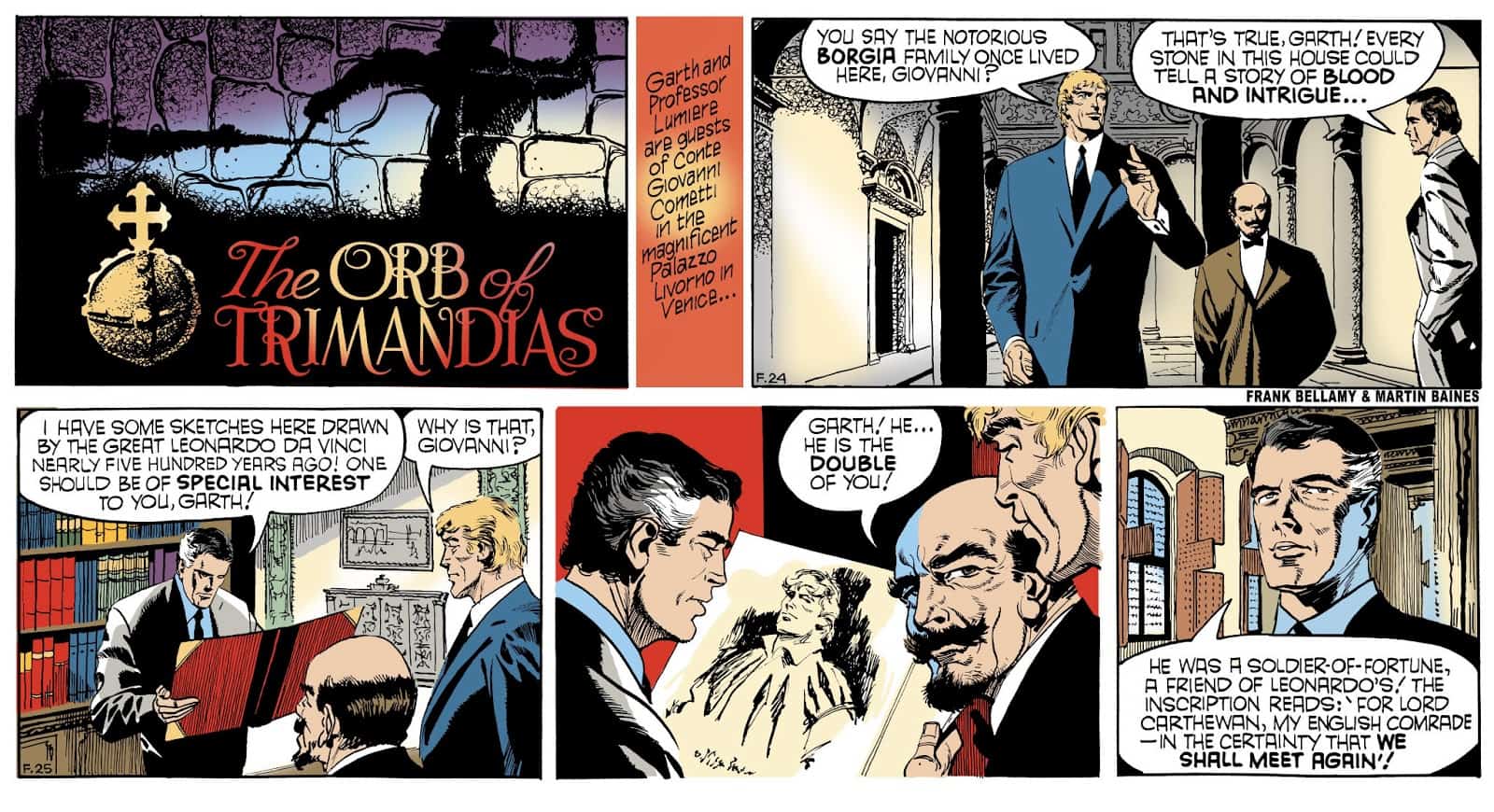
Mantova, nei comics, che sarebbe luogo ideale per un fumetto sia per il passato di storia che per le magnifiche locations, non è molto frequentata/citata  nei comics ma qua e la qualcosa si trova. Qui una citazione nell’avventura di Garth dal titolo  The Orb of Trimandias (28 January – 22 May 1972).

garth721

Garth was a comic strip in the British newspaper Daily Mirror from July 24, 1943, to March 22, 1997. The strip belonged to the action-adventure genre and recounted the exploits of the title character, an immensely strong hero who battled various villains throughout the world and many different chronological eras. Garth was widely syndicated throughout English-speaking countries during its long run. The 1960s Australian fast bowler Garth McKenzie was nicknamed after the comic strip hero.

Steve Dowling and Gordon Boshell were the originators of the Garth character. Dowling wanted to create a British adventure comic strip, and took inspiration from the American comic strips SupermanFlash Gordon and Terry and the Pirates. Dowling and Boshell took on 15-year-old John Allard to work on Garth, who stayed with the strip for its entire lifetime. After 59 adventures Dowling retired and handed Garth over to Allard, which he carried on until 1971 when Eagle comics‘ Dan Dare artist, Frank Bellamy, took over the art with Allard writing the scripts. Garth’s longevity had been established by Don Freeman, who created almost every basic Garth plot on which the saga was built. Peter O’DonnellJim Edgar and Angus Allan also wrote extensively for the strip during its decades-long existence. Philip Harbottle is a leading Garthexpert and collector of the strips, and he wrote several of the stories during the 1990s. Martin Asbury became Garth’s artist after Frank Bellamy’s death in 1976, drawing the strip and writing many of the stories until its final episode in 1997.

In 1993, Bill Storrie produced perhaps a dozen or so 60-page photocopied magazines titled The Gopherville Argus Special Edition No. 1 featuring Garth as a tribute to the writers and artists who had been involved with the strip. Most if not all Garth strips are now owned byMirror.

As of Wednesday 13 August 2008, “Garth” has reappeared on the website of the Daily Mirror, drawn by the artist Huw J. Davies. ( aka HuwJ & currently HuwJ Matsumura )

The Online Strip, was a Successful re- Visiting / Re-Imagineering of the character, Taking him back to the Pre-Steve Dowling Origins and Establishing him in a Historical Setting.

Having successfully worked in the Media Entertainment industry and Printed Media for over 3 decades ( Including Periods at Disney Warner and Fox ) Huw J believed that the Re Imagined version could easily cross from the Digital, back to the Printed medium, and Ultimately licensing to other media. This was Discussed and the future of the character in print was agreed upon. with a new ongoing Daily strip in print being Planned to run at the end of the 2nd Online story arc, King of New York. ( which also established the reasons behind the Characters Dislike for Guns)

However, due to an untimely accident involving Long standing cartoon editor Ken Layson, with who the agreement had been made things became muddied and internal politics with the Mirrorpix licensing arm of the newspaper created issues that delayed and inevitably halted this decision.

HuwJ decided to honor the characters History, and under the terms of his License re-branded the character tipping the hat to Don Freeman longtime writer of the strip by Giving Garth a Surname, the Graphic Novel Titled Captain Garth Freeman of the Armed Services and in 2010 was launched initially under British Publisher Markosia, and was a success! Selling out both at Specialist Comic Stores and Conventions, as well as Online. it was re-Published in 2013 By Pummie Productions ink, At first in its usual format and (also in 2013) with a New Cover by Spider-Man Artist and Stan Lee Collaborator Andy Tong it was repackaged with the Garth Title in Honor of the 70th Anniversary of the character with all proceeds going to Help for Heroes.

In 2015, Published again by Pummie Productions ink, the character Starred Alongside Sexton Blake, in the 1st of what is promised to be a series of Comic books, under the Captain Garth Freeman of the Armed Services title. this again sold out and if the team continues to publish the Comic it will be collected in a bumper edition after the 5th book.

HuwJ Believes that the online revamp of the character was the catalyst that got the longtime fans of the character to push for a return of the hero and what ultimately led the Newspaper and its Licensing arm to re-color the old strips and re launch them in the paper

Garth started a run of reprints in the Daily Mirror coloured by Martin Baines in the issue dated Monday 21 February 2011. and continues at present, the strip and the character are a testament to the longevity of good solid storytelling and characters with robust ideals. and looks to still have a promising future

from: wikipedia

from the New Yorker to FISH

Liam Francis Walsh: I’m a cartoonist, writer, and illustrator, originally from northern Wisconsin. I grew up on a dairy farm with lots of siblings and books and a pet crow. Now I live in the Italian part of Switzerland. My cartoons appear in The New Yorker magazine pretty frequently, and my first children’s book is available now!

fish

A boy and his dog embark on a fishing journey.
Their first catch of the day: a big fat letter F.
Their second? A slippery I.
After an epic journey beneath the lake’s surface, they find what they came for– a FISH, along with some unanticipated menace from a few other letters.

This clever, wordless picture book, by a popular New Yorker cartoonist, is filled with charm and heart and will have no problem swimming its way into the hearts of young readers.

July Sunday Xtina

July, the Sunday of Xtina is a comic-strip created by Monica

Xtina comic strips are centered on the life of Xtina in her work as assistant in a Museum. Xtina’s chronicles the daily challenges of a worker. At work, we follow Xtina as she copes with friends, relationships, and the day-to-day trials of a working woman living life in the 21st century.

Xtina’s comic-strip, subject, Art and Script-writer:

Dalla presentazione di Gianfranco Goria:

Eccola qui, Monica (figlia d’arte, mi dicono, con una naturale propensione, si direbbe, per le strip statunitensi, così efficaci, così difficili da fare bene). Eccola col suo tratto essenziale e pulito (perfetto per la rete, ma pubblicato sulla carta stampata), da leggere con leggerezza per ricavarne un sorriso e qualche pensiero intelligente.

Al momento l’autrice ha appena qualche anno in più della protagonista della sua striscia, XTINA, lavoratrice museuale diciannovenne ingabbiata in quel banco informazioni che, se da un lato la rende libera e autonoma, dall’altro la costringe a fuggire costantemente con la fantasia (da ex impiegato di concetto,  come la capisco…). L’arte arriva fino a quel banco, anche se magari non nel modo che la ragazza avrebbe voluto, ma non è l’unica a desiderare di più per la propria vita: c’è anche, per dire, un giovane in divisa che, per ora, sembra davvero fare tanta fatica a trovare quel che cerca… Ma, no, non ci si deve rassegnare! Oh, no. C’è tutta una vita davanti! In fondo “un anno nuovo è un foglio bianco tutto da scrivere”… Oh… cioé… insomma… cestini permettendo.

Immagino le sue giovani lettrici, immedesimarsi con estrema facilità. Immagino i padri delle sue lettrici, riconoscere (e forse scoprire) le proprie figlie. Immagino altre strisce e altre ancora che verranno e mi chiedo se XTINA crescerà anche lei, nel suo mondo a strisce, e troverà le cose belle della vita che la attendono, appena un poco più in là.