Tag Archivio per: sergio bonelli editore

Spingtime con Xtina

I Fumetti di Don Matteo

Nell’episodio della serie Don Matteo dal titolo “non è colpa delle stelle” compare un fumetto – tra le mani di Matteo/Terence Hill – che ha a che fare con il plot. Il titolo dell’albo – nella fiction – è “Storie di Tenebre” ma mentre viene sfogliato si nota, nella seconda di copertina, il promo de “Avventura Magazine” uscito nel maggio 2015. Si nota anche che il finto albo è formato da due albi – Bonelli – uniti. Mentre dal poco che si può carpire dallo sfogliamento veloce sembrano pagine di Lukas.

Ogni conferma o smentita è benvenuta.

Mary Perkins or Mary Atkins?

Mary Perkins/on Stage  è stata pubblicata per anni in Italia sulle pagine del quotidiano Il Giorno. Forse pochi ricordano che il nome della protagonista – e di conseguenza della strip – fu mutato in Mary Atkins. L’unica spiegazione si può cercare con la paralella presenza della strip Perkins di John Miles pubblicata sulla stessa pagina di comics.

… whoever has read the comics of Mary Atkins (1) published on “Il Giorno,” will note how the drawings are laid out through varied frame solutions with a highly technical assembly (the artist belongs to the great Alex Raymond school) with very unusual and  daring angles and perspectives inspired by cinematographic language, contrasts (frame after frame) with views from a distance, from above, to settings in which the “lens” (ideally speaking) focuses on the characters through the gap of another character’s arms, drawn in a foreground close-up etc.


(1) The name of the protagonist – and consequently the strip, was changed to Mary Atkins. The only explanation can be found in the parallel presence of the strip Perkins by John Miles published on the same comics page


from: Apocalittici e integrati, Umberto Eco, 1964

Visions are worth fighting for.

Visions are worth fighting for.

Outisfumetti quotes

Anna ‘n’ Mathias: No Hunting!

Anna ‘n’Mathias: No Hunting!

Maigret a Notre Dame

Maigret a Notre Dame

Galep disegna Adam?

Galep disegna Adam?

Sarebbe stato interessante, ma…

Stralcio di testo dalla presentazione del volume Adam.

Non si chiamava Adam, e non siamo nemmeno sicuri che fosse di origine statunitense. Uomini come lui ce ne sono molti in giro per il mondo, uomini che hanno reciso nettamente le loro radici. Noi ne abbiamo conosciuto uno, uno dei tanti. Ci siamo ispirati a lui o la sua vita calzava come un guanto alla nostra storia? Facciamo un salto indietro, un bel salto…

…Del personaggio ho già alcuni bozzetti fatti da disegnatori famosi (Galep, Magnus, ecc) che, beata incoscienza, avevo coinvolto ma che non avrebbero mai disegnato il fumetto…

He may not even have been called Adam, there are lots of men like him around the world, men who have clearly cut their roots, whatever the soil they fed on. No one chooses the place to be born in. When he revealed himself, just one among many, we “recognized” him and molded him. Did we draw inspiration from his life even before we knew him? Or did his life perfectly fit, like a glove with that cartoon strip we still had not written nor drawn?

One day we decided to go and rinse the palettes in the Tropical seas and go on a long holiday around the isle of Cuba.  We were really itching to see the places we had drawn and imagined and illustrated. Suddenly, one night, there he was!

Impossible but it’s him!

Seated at the same piano he played every night, Adam was there.

Giancarlo Malagutti made his debut with illustrations of some stories for the monthly Horror magazine, then worked with the Intrepido Albo and Monello, and later drew the strips of Zaniboni for Diabolik, after which decided to leave aside this work for screenplays.

Manlio Truscia Started with the strips of Tex in 1964. From the 70s to the 80s did the strips of Kriminal and Satanik and drew for Intrepido and Monello for the Universo editors, Edifumetto, Ediperiodici and Adamo of the Corno publishers. He later worked as a visualizer and illustrator.

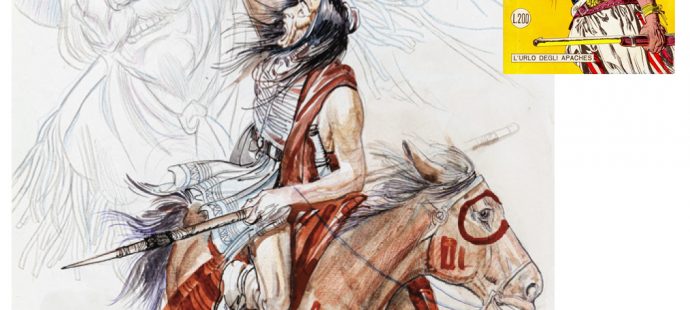
Cover inedita/alternativa di Sergio Tarquinio Storia del West

Cover inedita/alternativa di Sergio Tarquinio Storia del West 

Storia del West “l’urlo degli Apaches”, di Sergio Tarquinio

Storia del West cover alternativa di Sergio Tarquinio

Storia del West cover alternativa di Sergio Tarquinio

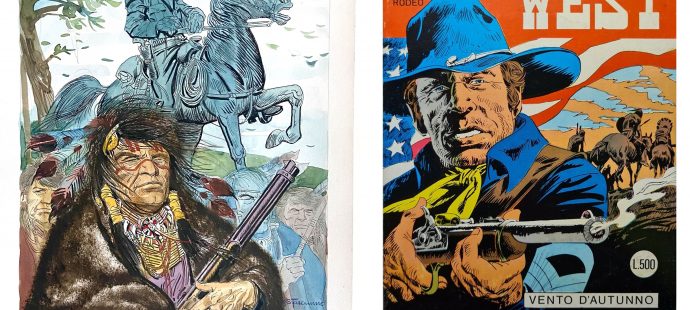
Copertina inedita Storia del West 61 “vento d’autunno”, di Sergio Tarquinio

In vendita: Segni & Disegni 

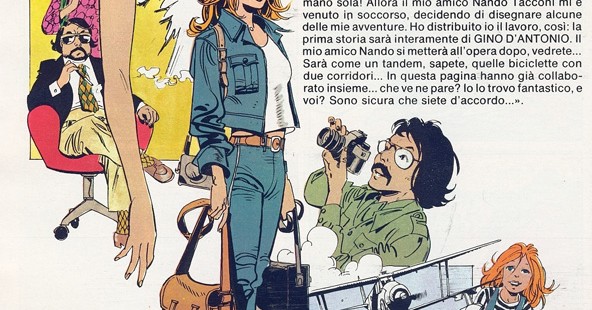
Susanna by Gino D’Antonio. quando un volume?

Susanna by Gino D’Antonio. quando un volume?

Luigi d’Antonio (16 March 1927 – 24 December 2006, Italy)

Gino d’Antonio started his professional career in 1947 with ‘Jess Dakota’ at Della Casa publishers. In 1950, he illustrated Mario Leone’s ‘Angeli della Strada’. Between 1951 and 1957, he was present at Il Vittorioso with ‘Il Trasvolatore dell Api’. In 1952, he went to work on Mondadori’s ‘Pecos Bill’ and ‘Oklahoma’ series. He was also present at Audace with some Bonelli scripted episodes of ‘El Kid’ and ‘I Tre Bill’.

In 1955, he was employed at a graphic studio directed by Piero and Roy D’Ami, where he worked for the British market. D’Antonio illustrated comics for Junior Mirror, Junior Express, Top Shot, Thriller Picture Library (‘Battler Britton’), Cowboy Picture Library (‘Gun Rule’), Fleetway Super Library and War Picture Library. He also did covers for Eagle and Boys World, and drew adaptations for traditional literature for Tell me Why and World of Wonder.

In 1967, he created ‘Il Storia del West’ for the publisher Sergio Bonelli. D’Antonio worked on this series until 1980, working together with artists like Renzo Calegari, Sergio Tarquinio and Renato Polese. In the late 1960s and early 1970s, d’Antonio cooperated on ‘La Avventure di Pace e di Guerra’ in Il Corriere dei Piccoli and with the magazine Supergulp. From 1970, he was present in Il Giornalinio with series like ‘Jim Lacy’ (scripts by Alberto Ongaro), and Susanna (artwork in cooperation with Renato Polese and Ferdinando Tacconi). He was a productive contributor to the series ‘Un Uomo, un’Avventura’, for which he provided artwork (‘L’Uomo di Zululand’, ‘L’Uomo di Iwo Jima’) and scripts illustrated by Tacconi (‘L’Uomo del Deserto’, ‘L’Uomo di Rangoon’) and Polese (‘L’Uomo di Pechino’).

from https://www.lambiek.net